
Pan
God of Nature, Shepherds, Music, and Panic in Greek Mythology
Born on -
Age: -
Profession:
Place of Birth:
General Characteristics and Symbolism
Pan exists in a state of constant contradiction. Ancient sources describe him as both a disruptive force that spreads fear and a joyful god who roams the countryside playing music, drinking wine, and participating in ecstatic celebrations. As the protector of shepherds and herds, he embodies harmony with nature; yet his lack of restraint, intense sexuality, and pursuit of pleasure have firmly associated him with **hedonism**.
This tension between terror and delight has ensured Pan’s longevity in cultural thought. In modern literature, he often appears as a symbol of humanity’s estrangement from instinct. In Tom Robbins’ novel Jitterbug Perfume, Pan is portrayed as a diminished god whose relevance fades in a world obsessed with power, immortality, and rigid belief systems.
Family and Origins
Pan’s genealogy varies significantly across mythological traditions. The most widespread account identifies his father as Hermes and his mother as the nymph Dryope. Other sources name the nymph Oineis as his mother, while a more unusual version claims that Hermes, disguised as a ram, fathered Pan with Penelope.
According to legend, Pan’s appearance at birth—horned, hairy, and goat-legged—was so terrifying that his mother fled in fear. Hermes, however, delighted in the child and carried him to Olympus, where the gods laughed at his strange form and entrusted him to the care of mountain nymphs.
Physical Depiction and Habitat
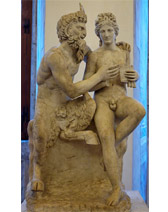
Pan is traditionally depicted with a human upper body, a shaggy beard, horns, and the legs and hooves of a goat. He is inseparably linked with Arcadia, a mountainous region that later became an enduring symbol of the idealized pastoral world. There, Pan protects sheep, goats, and cattle, aids hunters, and joins the revelries of mountain nymphs.
Despite his fearsome appearance, artistic traditions sometimes present Pan as a gentle figure wandering through fields and forests while playing his flute, embodying the rhythms and simplicity of rural life.
Myths and Legends
Syrinx and the Pan Flute
One of Pan’s most famous myths involves the river nymph Syrinx. While fleeing Pan’s pursuit, Syrinx prayed for deliverance and was transformed into reeds along a riverbank. Pan cut several reeds, bound them with wax, and created the syrinx, also known as the Pan flute—an instrument that remains inseparable from his identity.
Echo
In some traditions, the mountain nymph Echo rejected Pan and was killed as punishment. The echoes heard in mountainous regions were believed to be the lingering fragments of her disembodied voice.
Pitys
Pan fell in love with the nymph Pitys, who escaped his desire by transforming into a pine tree. In mourning, Pan adopted pine branches as a crown, a symbol that appears frequently in ancient depictions.
The Battle of Marathon
Pan was believed to have aided the Greeks during the Battle of Marathon by spreading supernatural terror among the Persian forces. After the victory, the Athenians built a sanctuary dedicated to Pan on the slopes beneath the Acropolis.
Midas and the Musical Contest
In later traditions, Pan is sometimes conflated with the satyr Marsyas. During a musical contest against Apollo, judged by King Midas, Pan’s music was deemed inferior. As punishment for his poor judgment, Apollo cursed Midas with donkey ears.
The Death of Pan
Pan is unique among Greek deities in that his death is explicitly proclaimed. According to legend, a sailor named Thamus heard a divine voice instructing him to announce upon reaching Palodes that “Great Pan is dead.” When the message was delivered, nature itself was said to mourn, filling the air with cries and lamentations.
Cultural Influence and Legacy
Pan was never included among the Twelve Olympian gods, and his worship was largely confined to caves, forests, and rural sanctuaries. In Late Antiquity, he was even regarded as a patron of satire and theatrical criticism.
His figure has left a deep imprint on later cultural frameworks, including Hedonism, Neopaganism, and Devil iconography, often compared to figures such as Baphomet. Elements of the Pan myth can also be traced in literature and popular culture, from Peter Pan to The Great God Pan.
Source: Biyografiler.com
Frequently asked questions about Pan
Who is Pan?, Pan biography, Pan life story, Pan age, Pan facts, Pan birthplace, Pan photos, Pan videos, Pan career

Lamine Yamal
Professional footballer

Erling Haaland
Professional footballer

Austin Abrams
Actor

Keanu Reeves
Actor

Kylian Mbappe
Professional footballer

Bad Bunny
Rapper, Songwriter


Hongjoong
Singer, Rapper, Songwriter, Composer

Ludacris
Rapper, Actor

Kwon Eunbi
Singer

Sarah Wayne Callies
Actress, Screenwriter, Producer, Director

LaTavia Roberson
Singer, Actress, Entrepreneur

Luiz Inacio Lula da Silva
Politician, President

Nicki Minaj
Rapper, Singer, Songwriter, Actress
Kylian Mbappe
Professional footballer

Ronaldinho
Professional footballer
Lamine Yamal
Professional footballer

Maria Corina Machado
Politician, Political Activist