
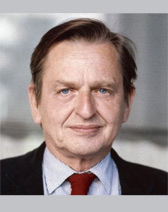
Olof Palme
Swedish Prime Minister and leading advocate of disarmament
Born on January 30, 1927
Died on February 28, 1986
Age at death: 59
Profession: Politician
Place of Birth: Östermalm, Stockholm, Sweden
Place of Death: Stockholm, Sweden
Sven Olof Joachim Palme, known internationally as Olof Palme, was one of the most influential political leaders of the Cold War era. A strong supporter of nuclear disarmament and global justice, he was widely recognized for advocating the interests of developing countries and for his outspoken criticism of both Western and Eastern power blocs. He was assassinated on 28 February 1986 in Stockholm, in a crime that remains one of Sweden’s most traumatic unsolved cases.
Olof Palme was born on 30 January 1927 in the Östermalm district of Stockholm, Sweden, into an upper-class, conservative Lutheran family. His father, Gunnar Palme, was a businessman, and his mother was Elisabeth von Knieriem. Palme lost his father at the age of six. Due to recurring health issues during childhood, he was educated largely by private tutors and acquired proficiency in German and English at an early age. He completed his secondary education at Sigtunaskolan Humanistiska Läroverket.
In January 1945, while preparing for university, Palme was conscripted into the Swedish Army because of the Second World War. He completed his compulsory service between 1945 and 1947 in the Svea Artillery Regiment and became a reserve officer with the rank of artillery captain in 1946. After his discharge in March 1947, he enrolled at Stockholm University. With a scholarship, he studied from 1947 to 1948 at Kenyon College in Ohio, United States. He later traveled across the United States and Mexico by hitchhiking before returning to Sweden to study law at Stockholm University.
Olof Palme joined the Swedish Social Democratic Party in 1949 and steadily rose through its ranks. He was elected to parliament in 1957. In the early 1960s, he became a member of the National Board for International Development, where he worked on aid and educational programs for developing countries. In 1963, he was appointed Minister without Portfolio and served as a close political advisor to Prime Minister Tage Erlander. He later became Minister of Communications in 1965 and Minister of Education in 1967, where he faced strong criticism from left-wing student movements during debates over university reform.
When Tage Erlander resigned in 1969, Olof Palme was elected leader of the Social Democratic Party and succeeded him as Prime Minister. He served two terms as Prime Minister of Sweden, from 14 October 1969 to 8 October 1976 and again from 8 October 1982 until his death on 28 February 1986.
During his time in office, Palme strengthened labor unions, expanded the welfare state, reinforced the healthcare and social security systems, and invested heavily in education. He reduced remaining political powers of the monarchy and introduced major reforms, including the expansion of preschool education and legislation encouraging women’s participation in the workforce to combat gender inequality.
On the international stage, Olof Palme was an exceptionally outspoken figure. He criticized both the United States and the Soviet Union, condemning the Soviet invasion of Czechoslovakia in 1968 and sharply denouncing the U.S. bombing of North Vietnam in 1972, which he compared to atrocities committed in Nazi concentration camps. These remarks temporarily froze diplomatic relations between Stockholm and Washington.
“I do not regret it, because in this world you have to speak loudly to be heard. I cannot remain silent, and I will not yield to pressure to keep quiet.”
Palme described South Africa’s apartheid regime as “particularly horrifying” and provided financial support to the African National Congress. He openly condemned the dictatorship of Francisco Franco in Spain, campaigned for nuclear disarmament, and served as a mediator during the Iran–Iraq War in the 1980s in an effort to achieve peace.
Shortly before his death, the Swedish government declared the PKK a terrorist organization. Palme was an atheist.
Olof Palme was married twice. His first marriage was to Jelena Rennerova (1949–1952). In 1956, he married Lisbeth Palme, with whom he remained until his death. They had three children: Joakim Palme (b. 1958), Mårten Palme (b. 1961), and Mattias Järvinen Palme (b. 1968).
On the night of 28 February 1986, Olof Palme was shot at close range while walking home from a cinema with his wife in central Stockholm. He died at the age of 59. The assassination shocked Sweden and the world.
The murder remained unsolved for decades. In 2020, Swedish Prosecutor Krister Petersson announced that the prime suspect was Stig Engström, who had died in 2000, concluding that he acted alone. As the suspect was deceased and could not be questioned, the case was formally closed.
Source: Biyografiler.com
Frequently asked questions about Olof Palme
Who is Olof Palme?, Olof Palme biography, Olof Palme life story, Olof Palme age, Olof Palme facts, Olof Palme birthplace, Olof Palme photos, Olof Palme videos, Olof Palme career

Lamine Yamal
Professional footballer

Erling Haaland
Professional footballer

Kylian Mbappe
Professional footballer

Austin Abrams
Actor

Bad Bunny
Rapper, Songwriter

Sam Altman
Entrepreneur, Investor, CEO


Hongjoong
Singer, Rapper, Songwriter, Composer

Ludacris
Rapper, Actor

Kwon Eunbi
Singer

Sarah Wayne Callies
Actress, Screenwriter, Producer, Director

LaTavia Roberson
Singer, Actress, Entrepreneur
Bad Bunny
Rapper, Songwriter

Margot Robbie
Actress
Kylian Mbappe
Professional footballer

Neymar
Professional footballer

Pedro Sanchez
Politician

Ronaldinho
Professional footballer