
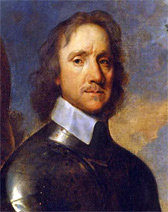
Oliver Cromwell
Lord Protector of the Commonwealth
Born on April 25, 1599
Died on September 3, 1658
Age at death: 59
Profession: Military Commander, Statesman
Place of Birth: Huntingdon, England
Place of Death: Whitehall Palace, London, England
Oliver Cromwell was the central political and military figure of the English Civil Wars and the only ruler in English history to abolish the monarchy and govern England as a republic. From 1653 until his death in 1658, he ruled England, Scotland, and Ireland as Lord Protector, exercising near-absolute power. Although he rejected the title of king, his rule was effectively a military-backed dictatorship rooted in Puritan moral discipline and republican ideology.
Oliver Cromwell was born on April 25, 1599, in Huntingdon, England, into a prosperous family enriched during the sixteenth century through the confiscation of church lands. His grandfather was Sir Thomas Cromwell, a powerful minister of Henry VIII who played a decisive role in the English Reformation before being executed in 1540. Cromwell received his higher education at Cambridge University. He was a deeply religious Puritan, committed to a strict interpretation of Protestant morality and opposed both Catholicism and the established Anglican hierarchy.
In the late 1620s, Cromwell emerged as a passionate supporter of the Puritan movement, which opposed the policies of the royal court and the religious direction favored by King Charles I. In 1628, he was elected to Parliament from Huntingdon and quickly gained recognition, but Parliament was dissolved in 1629. Cromwell withdrew to his rural estate and lived as a devout country gentleman until political tensions resurfaced.
In 1640, he was elected as a Member of Parliament for Cambridge University to what became known as the Long Parliament. Under Cromwell’s leadership, the Puritans confronted King Charles I over taxation, religious authority, and absolute monarchy. These conflicts escalated into the English Civil War in 1642, dividing the nation between royalist forces and parliamentary supporters.
Cromwell joined the parliamentary army as a cavalry officer and soon assumed command of the eastern counties. He founded the elite Puritan cavalry unit known as the “Ironsides,” whose discipline, religious zeal, and battlefield effectiveness became legendary. His enemy, the royalist statesman Edward Hyde, Earl of Clarendon, described Cromwell’s army as the most disciplined and formidable force of its time.
Cromwell enforced strict military discipline. Soldiers who neglected duty, mistreated civilians, or damaged property faced severe punishment, including execution. His forces became the backbone of the New Model Army, the first professional standing army in English history, distinguished by its red uniforms, which later became symbolic of British military identity.
Cromwell rose to the rank of general and secured decisive victories, notably in 1644 and 1645. By May 1646, the royal stronghold of Oxford was besieged. In 1648, Cromwell crushed the remaining royalist armies, achieving complete military victory. King Charles I, having attempted to manipulate divisions within Parliament and seek foreign intervention, was placed on trial for treason.
Despite claims by the king that no court had authority to judge a monarch, Cromwell insisted that Charles I be held accountable for betraying his nation. On January 27, 1649, Charles was sentenced to death and executed on January 30, 1649, in the courtyard of Whitehall Palace. This act permanently ended the English monarchy and shocked Europe.
Following the king’s execution, Cromwell consolidated power and launched brutal military campaigns in Ireland and Scotland. In 1651, Charles II proclaimed himself king in Scotland and invaded England, but Cromwell decisively defeated him at the Battle of Worcester. Cromwell returned to London as commander-in-chief and de facto head of state, taking residence in Whitehall Palace.
Political instability, economic hardship, and religious division soon plagued the Commonwealth. Cromwell clashed repeatedly with Parliament, which resisted his vision of a strong executive authority and full religious toleration. In April 1653, after delivering a furious speech, Cromwell forcibly dissolved the Rump Parliament with armed soldiers, declaring its moral corruption and political incompetence.
Later that year, Cromwell was proclaimed “Lord Protector of England, Scotland, and Ireland,” ruling alone with sweeping authority. He restored order, upheld religious tolerance for all Protestant sects except Catholicism and episcopacy, strengthened the navy, and pursued an assertive foreign policy. His ambition was to establish a Protestant alliance across Northern Europe, maintaining diplomatic relations with Sweden and resolving conflicts with Denmark and Portugal.
In 1657, Cromwell was offered the crown, but he rejected the title of king due to opposition from the army. His health deteriorated rapidly, worsened by malaria and personal grief following the death of his daughter Elizabeth Claypole. He died on September 3, 1658, at Whitehall Palace, at the age of 59.
Oliver Cromwell married Elizabeth Bourchier in 1620 and had numerous children, including Richard Cromwell, who briefly succeeded him as Lord Protector. Richard proved incapable of ruling, and political chaos followed. In 1660, General George Monck restored the monarchy. Charles II returned to England and reclaimed the throne.
In a symbolic act of revenge, Cromwell’s body was exhumed from Westminster Abbey in 1661, hanged at Tyburn, beheaded, and buried in an unmarked grave. His severed head was displayed on a spike atop Westminster Hall for decades before eventually being buried in 1960 at Sidney Sussex College, Cambridge.
Despite his controversial legacy, Oliver Cromwell remains one of the most consequential figures in English history. He was England’s first and last republican dictator, a man driven by religious conviction, political ruthlessness, and an unyielding belief in moral governance and liberty of conscience.
Selected Quotations:
“Do not trust those who praise you, for when you are hanged, they will praise you even more.”
“He who stops being better stops being good.”
“Trust in God, but keep your powder dry.”
Source: Biyografiler.com
Frequently asked questions about Oliver Cromwell
Who is Oliver Cromwell?, Oliver Cromwell biography, Oliver Cromwell life story, Oliver Cromwell age, Oliver Cromwell facts, Oliver Cromwell birthplace, Oliver Cromwell photos, Oliver Cromwell videos, Oliver Cromwell career

Lamine Yamal
Professional footballer

Kylian Mbappe
Professional footballer

Sam Altman
Entrepreneur, Investor, CEO

Erling Haaland
Professional footballer

Alice Weidel
Politician, Economist

Giorgia Meloni
Politician, Journalist


Hongjoong
Singer, Rapper, Songwriter, Composer

Ludacris
Rapper, Actor

Kwon Eunbi
Singer

Sarah Wayne Callies
Actress, Screenwriter, Producer, Director

LaTavia Roberson
Singer, Actress, Entrepreneur

Snoop Dogg
Rapper, Singer, Actor

Josh Duhamel
Actor

Sergio Perez
Formula 1 Driver

Brad Pitt
Actor

Florence Pugh
Actress

Naomi Watts
Actress