
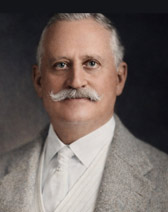
Minor Cooper Keith
Architect of the Banana Empire and Co-founder of United Fruit Company
Born on January 19, 1848
Died on June 14, 1929
Age at death: 81
Profession: Businessperson, Entrepreneur
Place of Birth: Brooklyn, New York, United States
Place of Death: New York, United States
Minor Cooper Keith was an American businessman whose ventures in railroads, commercial agriculture, and maritime transport profoundly reshaped the economies of Central America. Widely regarded as one of the pioneers of the global banana trade, he emerged as a central figure in the rise of export-driven agriculture in the region. Together with Andrew Preston, he co-founded United Fruit Company, later known globally through the brand Chiquita, establishing a corporate empire that would influence politics, labor systems, and international trade for decades.
Early Life and Background
Minor Cooper Keith, January 19, 1848 tarihinde United States’nın New York eyaletindeki Brooklyn kentinde doğmuştur. He was born into a family engaged in commerce; his father, Minor Hubbell Keith, was a timber merchant, while his mother, Emily Meiggs, came from a family connected to large-scale infrastructure projects. His early exposure to ambitious engineering and investment ventures came through his uncle Henry Meiggs, a prominent figure in railroad construction across the Americas.
Keith entered working life at a young age, initially employed as a clerk before transitioning into the timber business. He later experimented with cattle ranching in Texas, demonstrating an early inclination toward large-scale, land-based enterprises. These formative experiences shaped his entrepreneurial instincts and prepared him for the challenges he would soon face in Central America.
Railroad Expansion and Costa Rica Venture
In 1871, at the age of 23, Minor Cooper Keith traveled to Costa Rica to participate in a major infrastructure project: the construction of a railroad linking the capital, San José, to the Caribbean port of Limón. The project aimed to modernize the country’s export capabilities, particularly for coffee. However, the endeavor proved extraordinarily difficult due to dense tropical forests, mountainous terrain, heavy rainfall, and deadly diseases such as malaria and yellow fever.
Following the death of his uncle Henry Meiggs in 1877, Keith assumed control of the project. Thousands of workers—brought from Jamaica, China, and Italy—labored under extreme conditions, and many perished during construction. Despite financial crises and logistical setbacks, Keith secured funding from London banks and investors, ensuring the continuation of the project.
In return for completing the railway, the Costa Rican government granted him approximately 800,000 acres of tax-exempt land along with a 99-year operational concession. By 1890, the railroad was completed, fundamentally transforming the country’s export infrastructure and integrating it more deeply into global trade networks.
The Rise of the Banana Trade
During the construction of the railway, Minor Cooper Keith began planting banana trees along the tracks to provide food for workers. Recognizing the crop’s commercial potential, he pivoted toward banana cultivation as a primary business. He established a steamship route between Limón and New Orleans, enabling large-scale export of bananas to the United States.
Keith founded the Tropical Trading and Transport Company, creating a vertically integrated system that combined plantation agriculture, transportation, and export logistics. Within a short period, bananas surpassed coffee as a more profitable export commodity, marking a decisive shift in the economic orientation of the region.
Formation of United Fruit Company
Expanding his operations into Panama and Colombia, Minor Cooper Keith gained control over a substantial portion of the banana trade in Central America. In 1899, he merged his business interests with Andrew Preston’s Boston Fruit Company to form United Fruit Company. He assumed the role of vice president, while the newly formed entity rapidly grew into one of the most powerful corporations operating in the Western Hemisphere.
The company developed an extensive network of railways, ports, and plantations, effectively controlling both production and distribution. Its influence extended beyond economics into politics, shaping governance structures in several countries and giving rise to the term “banana republic” to describe nations heavily dependent on a single export commodity and influenced by foreign corporate interests.
Other Business Ventures and Expansion
Beyond bananas, Minor Cooper Keith diversified his investments across multiple sectors. He was involved in gold mining operations in Costa Rica and founded International Railways of Central America, further expanding transportation infrastructure across the region. His activities were not limited to Central America; he also invested in real estate in Florida and contributed to development projects around Panama City, including tourism-oriented ventures.
These initiatives reflected his broader vision of integrated economic development, combining infrastructure, agriculture, and international trade. His ability to operate across industries reinforced his position as a dominant economic force in the Americas during the late 19th and early 20th centuries.
Personal Life
Minor Cooper Keith strengthened his influence in Costa Rica through marriage to Cristina Castro Fernández, the daughter of former president José María Castro Madriz. This alliance connected him directly to the country’s political elite, facilitating the expansion of his business interests and securing favorable agreements.
Controversies and Historical Impact
The legacy of Minor Cooper Keith remains deeply contested. Critics argue that his vast land concessions, reliance on low-wage labor, and political influence contributed to the formation of exploitative economic systems known as “banana republics.” These systems often prioritized corporate profits over local development and sovereignty.
Supporters, however, emphasize his role in modernizing infrastructure, creating export industries, and integrating Central American economies into global markets. His projects introduced railways, ports, and logistical systems that would otherwise have taken decades to develop.
Death
Minor Cooper Keith spent his final years in New York City. He died on June 14, 1929, due to bronchial pneumonia.
Source: Biyografiler.com
Frequently asked questions about Minor Cooper Keith
Who is Minor Cooper Keith?, Minor Cooper Keith biography, Minor Cooper Keith life story, Minor Cooper Keith age, Minor Cooper Keith facts, Minor Cooper Keith birthplace, Minor Cooper Keith photos, Minor Cooper Keith videos, Minor Cooper Keith career
Related Biographies

Lamine Yamal
Professional footballer

Erling Haaland
Professional footballer

Kylian Mbappe
Professional footballer

Sam Altman
Entrepreneur, Investor, CEO

Giorgia Meloni
Politician, Journalist

Scott Bessent
Politician, Investor


Hongjoong
Singer, Rapper, Songwriter, Composer

Ludacris
Rapper, Actor

Kwon Eunbi
Singer

Sarah Wayne Callies
Actress, Screenwriter, Producer, Director

LaTavia Roberson
Singer, Actress, Entrepreneur

Alice Weidel
Politician, Economist
Lamine Yamal
Professional footballer

Elena Andreyevna Rybakina
Professional Tennis Player

Delcy Rodriguez
Politician, Lawyer, Diplomat

Jared Kushner
Businessperson, Political Consultant

Al Pacino
Actor