
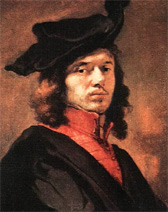
Johannes Vermeer
The Painter of Silent Interiors and Light
Born on October 31, 1632
Died on December 15, 1675
Age at death: 43
Profession: Painter
Place of Birth: Delft, Dutch Republic
Place of Death: Delft, Dutch Republic
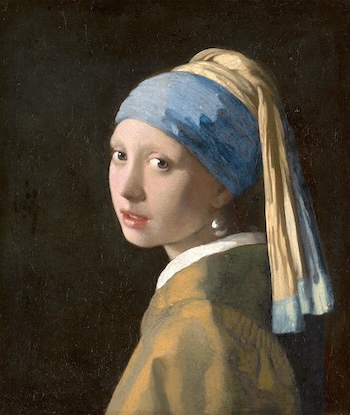
Johannes Vermeer was a Flemish painter who reflected the stillness of Northern European domestic life through softly diffused light and intimate interior scenes. Although his genius was only rediscovered nearly two centuries after his death, he is now regarded as one of the most important artists of the Dutch Golden Age. His most famous work, Girl with a Pearl Earring, is often described as the “Mona Lisa” of Flemish painting.
Painted around 1667, Girl with a Pearl Earring is not a conventional portrait but an imagined figurative study, known as a tronie—a character depiction rather than a likeness of a specific individual. The painting portrays a young girl wearing exotic clothing, an oriental turban, and a large pearl earring, her face emerging softly from darkness through Vermeer’s masterful use of light.
Johannes Vermeer, also known as Jan Vermeer, was born on October 31, 1632, in the city of Delft in the Dutch Republic, to Digna Balthasars and Reynier Jansz. Definitive information about his life is limited, but it is known that his father was a middle-class silk worker who later became an innkeeper and art dealer. Reynier Jansz operated inns such as the “Flying Fox” and later a larger establishment in Delft’s market square, while also engaging in the trade of artworks.
After his father’s death in 1652, Vermeer took over both the inn in Mechelen and the family art business. In 1653, he married the devout Catholic Catharina Bolnes. Despite opposition from her mother, Maria Thins, the marriage proceeded, and the couple eventually lived together with Maria Thins in the same household. Vermeer and Catharina had fourteen children, of whom ten survived into later life.
Vermeer became a member—and later the head—of the local painters’ guild during the early years of his marriage. His earliest works followed the conventions of the time, consisting mainly of large-scale religious paintings. Among these were Christ in the House of Martha and Mary (c.1654–1656) and Saint Praxedis (1655), the latter characterized by a comparatively dark use of light. His only mythological painting, Diana and Her Companions (c.1653–1654), also belongs to this early period.
One of his early signed works, The Procuress (1656), reveals warm colors and dramatic light-shadow contrasts, reflecting the influence of Caravaggio rather than the Rembrandt school with which it is sometimes associated. Shortly thereafter, Girl Reading a Letter at an Open Window marked the beginning of Vermeer’s mature and distinctive style.
Vermeer worked with extraordinary patience and precision, often using expensive pigments such as ultramarine blue and rich yellows. Because of his slow and meticulous working process, he produced relatively few paintings. During his lifetime, only a small number of his works were sold, and at his death most remained in the possession of his family.
Although Protestant by birth, Vermeer’s marriage into a Catholic household influenced both his personal and artistic life. His education remains uncertain, but it is widely believed that he studied under Carel Fabritius, a former pupil of Rembrandt. Vermeer signed approximately sixty works but dated only a few, including The Procuress (1656), The Astronomer (1668), and The Geographer (1669), which serve as key reference points for dating his oeuvre.
Unlike many of his contemporaries who favored outdoor scenes, Vermeer focused primarily on interior spaces. His paintings often depict one or two figures positioned near a window on the left side, bathed in soft, natural light. Scenes of music lessons, kitchens, letter reading, and quiet domestic moments dominate his work. Objects within these interiors—chairs, carpets, musical instruments, and household items—are rendered with remarkable realism and emotional presence.
Vermeer’s ability to imbue everyday objects with individuality and symbolic weight sets him apart from other Flemish painters. His compositions are not only technically flawless in perspective and shading but also explore philosophical themes such as time, stillness, existence, and the nature of perception.
Among his most celebrated works are The Milkmaid (1658), The Art of Painting (1666), and View of Delft (c.1660). View of Delft is particularly notable for its near-photographic clarity and stands as one of only two known outdoor cityscapes by Vermeer. This painting later gained literary significance through its appearance in Marcel Proust’s novel In Search of Lost Time.
By the 1660s, Vermeer’s style had fully matured. His color palette became brighter and more luminous, while his brushwork grew increasingly invisible, lending his paintings a photographic quality long before the invention of photography. Despite his artistic mastery, Vermeer struggled financially, especially during the political and economic turmoil of 1672, when French, English, and German forces attacked the Dutch Republic. The resulting crisis devastated trade, forcing Vermeer into debt as both a painter and art dealer.
On December 15, 1675, Johannes Vermeer died in Delft at the age of forty-three. His wife later stated in writing that the immense financial pressures and stress he endured contributed directly to his sudden mental collapse and death. He left his family burdened with debt and little financial security.
Rooted in the Flemish painting tradition of the 15th century, Vermeer refined and transformed its principles into a uniquely quiet and introspective visual language. Though largely unknown during his lifetime and forgotten for generations, his rediscovery in the late 19th century revealed him as one of the most profound and influential painters of 17th-century Dutch art, whose legacy continues to shape the understanding of light, space, and silence in painting.
Source: Biyografiler.com
Frequently asked questions about Johannes Vermeer
Who is Johannes Vermeer?, Johannes Vermeer biography, Johannes Vermeer life story, Johannes Vermeer age, Johannes Vermeer facts, Johannes Vermeer birthplace, Johannes Vermeer photos, Johannes Vermeer videos, Johannes Vermeer career

Lamine Yamal
Professional footballer

Kylian Mbappe
Professional footballer

Sam Altman
Entrepreneur, Investor, CEO

Erling Haaland
Professional footballer

Alice Weidel
Politician, Economist

Giorgia Meloni
Politician, Journalist


Hongjoong
Singer, Rapper, Songwriter, Composer

Ludacris
Rapper, Actor

Kwon Eunbi
Singer

Sarah Wayne Callies
Actress, Screenwriter, Producer, Director

LaTavia Roberson
Singer, Actress, Entrepreneur

Alfred Molina
Actor
Lamine Yamal
Professional footballer

Kendall Jenner
Model

Ronaldinho
Professional footballer

Rob Jetten
Politician

Geoffrey Hinton
Psychologist, Computer Scientist