
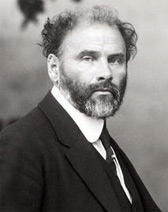
Gustav Klimt
Golden Visionary of the Vienna Secession
Born on July 14, 1862
Died on February 6, 1918
Age at death: 56
Profession: Painter
Place of Birth: Vienna, Austria
Place of Death: Vienna, Austria
Gustav Klimt was a painter and graphic artist who became one of the most important representatives of the Vienna Secession movement. He was born on July 14, 1862, in Vienna, as the second of seven children of the Bohemian gold engraver Ernst Klimt and Viennese Anna Finster. From an early age, Gustav Klimt and his brothers, Ernst Klimt and Georg Klimt, demonstrated strong artistic talent, following in their father’s footsteps. After completing eight years of primary education, Klimt entered the Vienna School of Arts and Crafts (Kunstgewerbeschule) at the age of fourteen, one of the most prestigious art institutions of the city.
In 1877, his brother Ernst also enrolled at the same school. During their studies, Gustav Klimt and his brother became close friends with another young painter, Franz Matsch. Together, under the guidance of Professor Ferdinand Laufberger, one of Vienna’s most influential figures, they studied a wide range of techniques including mosaic, painting, and fresco for seven years. The three worked in close collaboration, and Laufberger frequently secured external design commissions for them. While studying at the School of Applied Arts, Klimt was strongly influenced by the historical painter Hans Makart, whose grand decorative style left a lasting impression on his early work.
From 1880 onward, the group began working under their own names. In 1883, the three artists founded the Künstlercompagnie (Artists’ Company). After this date, Gustav Klimt worked as a decorator together with his brother Ernst and Franz Matsch. Their first major commission came in 1886, when they were entrusted with the decoration of Vienna’s new City Theatre, the Burgtheater. They were responsible for depicting scenes from the history of theater on the building’s pediment and stairway ceilings. Klimt’s contribution stood apart from those of his collaborators, as he combined classical motifs with portraits rendered in near-photographic realism. Works such as The Theatre in Taormina reflected this distinctive approach. He was also commissioned to document the interior of the old Burgtheater and portray members of Viennese high society before the building’s demolition, resulting in the gouache work Auditorium of the Old Burgtheater. These projects received widespread praise, and in 1888 Klimt was awarded a gold medal by Austro-Hungarian Emperor Franz Joseph I.
In 1890, the Künstlercompagnie received a commission that marked the confirmation of their artistic maturity: the completion of the interior decoration of the Kunsthistorisches Museum in Vienna, intended to display imperial collections. The decorative program aimed to present art history from Ancient Egypt to sixteenth-century Florence. The task had originally been assigned to Hans Makart, but following his death, Klimt and his colleagues successfully completed the unfinished staircase decorations. In this project, Klimt introduced a new element that foreshadowed his later style: the depiction of a contemporary woman dressed in historical costume. This marked a clear stylistic departure from his partners and contributed significantly to the spread of his reputation, particularly through portrait commissions characterized by photographic precision.
After completing the Burgtheater and Kunsthistorisches Museum projects, Klimt abandoned collaborative work in 1892 following the death of his brother Ernst. That same year, he also lost his father, which led him into a profound personal and artistic crisis. These events ultimately caused the dissolution of the Künstlercompagnie.
In 1897, Gustav Klimt co-founded the Vienna Secession with a group of progressive artists and was elected its first president, a position he held until 1905. The movement sought to break away from academic conservatism and promote modern artistic expression. A few years later, Klimt received a commission to paint ceiling panels for the Great Hall of the University of Vienna, representing the allegories of Philosophy, Medicine, and Jurisprudence. Instead of glorifying rational science, his works were filled with erotic symbolism and pessimistic undertones, provoking intense public and academic backlash.
The University of Vienna commission, awarded in 1894, became one of the greatest scandals of Klimt’s career. When the unfinished Philosophy panel was publicly exhibited in 1900, reactions from both the academy and the press were extremely harsh. Klimt was accused of obscenity and artistic incompetence, and the subsequent panels intensified the controversy. In 1904, he returned the commission fees and reclaimed the works. This episode marked the end of his involvement in state-sponsored projects and led him to adopt the radical decision to avoid public commissions altogether.
In 1902, Klimt created mural decorations for the dining room of the Stoclet Palace in Brussels, considered the masterpiece of his architect friend Josef Hoffmann. In 1905, he exhibited fifteen works at the second annual exhibition of the German Artists’ Confederation in Berlin, where he won the Villa Romana Prize. The following years included travels to Belgium, England, Florence, Paris, Madrid, Toledo, and Brussels. In 1906, he was named an honorary member of the Royal Bavarian Academy of Fine Arts in Munich.
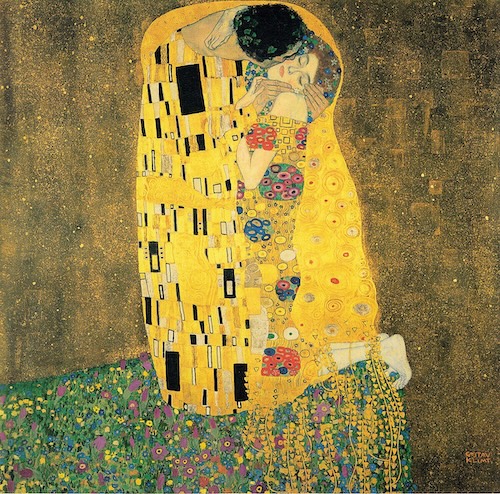
Between 1907 and 1908, Klimt painted his most famous work, The Kiss, which was exhibited at the Vienna Art Exhibition in 1908 and immediately purchased by the Imperial Ministry of Culture and Education. In his late works, including The Kiss, Portrait of Fritza Riedler, and Portrait of Adele Bloch-Bauer, he increasingly reduced figures to silhouette-like forms, emphasizing ornament and symbolic abstraction. Today, these masterpieces are housed in the Austrian Gallery.
Gustav Klimt continued to exhibit internationally throughout the early twentieth century, participating in major exhibitions in Prague, Dresden, Munich, Venice, Rome, Budapest, Mannheim, and Berlin. In 1912, he was appointed president of the Austrian Artists’ Association. His influence extended beyond painting, particularly through his drawings, which played a significant role in shaping the artistic development of Egon Schiele and Oskar Kokoschka.
Gustav Klimt died on February 6, 1918, in Vienna as a result of a stroke. His family declined burial in an honorary grave, and he was laid to rest in a modest grave in Vienna.
Major Works
The Kiss, Love, Music I, Portrait of a Woman, Medicine, Living Water, Death and Life, Adam and Eve, The Three Ages of Woman, Salome
In a notable posthumous event, Gustav Klimt’s portrait of Elisabeth Lederer was auctioned at Sotheby’s in New York on November 18, 2025. Painted between 1914 and 1916, the nearly 1.8-meter-tall portrait sold for 236.4 million dollars after a twenty-minute bidding war. Depicting the daughter of one of Vienna’s wealthiest families draped in a robe reminiscent of an East Asian emperor, the painting is one of only two full-length Klimt portraits held in private collections.
Source: Biyografiler.com
Frequently asked questions about Gustav Klimt
Who is Gustav Klimt?, Gustav Klimt biography, Gustav Klimt life story, Gustav Klimt age, Gustav Klimt facts, Gustav Klimt birthplace, Gustav Klimt photos, Gustav Klimt videos, Gustav Klimt career

Lamine Yamal
Professional footballer

Sam Altman
Entrepreneur, Investor, CEO

Kylian Mbappe
Professional footballer

Erling Haaland
Professional footballer

Alice Weidel
Politician, Economist

Giorgia Meloni
Politician, Journalist


Hongjoong
Singer, Rapper, Songwriter, Composer

Ludacris
Rapper, Actor

Kwon Eunbi
Singer

Sarah Wayne Callies
Actress, Screenwriter, Producer, Director

LaTavia Roberson
Singer, Actress, Entrepreneur
Lamine Yamal
Professional footballer

Kaia Gerber
Model, Actress
Giorgia Meloni
Politician, Journalist
Kylian Mbappe
Professional footballer

Austin Abrams
Actor

Eliezer Yudkowsky
Researcher, Writer