
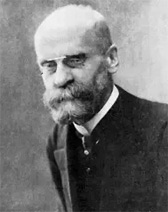
Emile Durkheim
Founder of Modern Sociology
Born on April 15, 1858
Died on November 15, 1917
Age at death: 59
Profession: Sociologist, Philosopher, Academic
Place of Birth: Épinal, Lorraine, France
Place of Death: Fontainebleau, near Paris, France
Émile Durkheim is regarded as one of the founders of modern sociology. Although the term “sociology” was coined by Auguste Comte, Durkheim established sociology as an independent, scientific discipline. Through his systematic methods, institutional foundations, and theoretical depth, he shaped sociology into a rigorous field of study distinct from philosophy and psychology.
Émile Durkheim, whose full name was David Émile Durkheim, was born on April 15, 1858, in the small French town of Épinal in the Lorraine region. He was the son of a Jewish chief rabbi. His father wished him to follow the same religious path, but Durkheim eventually chose an academic career. He was an outstanding student at the Lycée Louis-le-Grand and, following his father’s death, entered one of France’s most prestigious institutions, the École Normale Supérieure, in 1879. He graduated in 1882. During his studies, he developed a strong interest in philosophy.
Although sociology would later become his defining field, Durkheim began his career as a philosophy teacher because sociology was not yet taught in secondary schools or universities in France. He taught philosophy in various French high schools after 1882. In 1885, he traveled to Germany for research, where he worked at several institutions and conducted studies in social sciences and moral philosophy. He later compiled his experiences into academic reports. By 1887, at the age of twenty-nine, Durkheim was already recognized as a promising figure in social science and social philosophy.
On July 20, 1887, following a ministerial decision, Émile Durkheim was appointed lecturer in social science and pedagogy at the University of Bordeaux. There, he carried out uninterrupted research that laid the foundations of sociology as a scientific discipline. French sociology owed much of its late nineteenth-century influence to Durkheim and to the academic journal L’Année Sociologique, which he founded in 1896.
Durkheim was deeply engaged with social events and reform movements in France. At the École Normale Supérieure, where philosophical and political debates were intense, his interest in social phenomena was evident to both his peers and instructors. He systematically developed his ideas on society, morality, and collective life, shaping a new scientific approach to understanding social reality.
In 1887, Émile Durkheim married Louise Dreyfus. The couple had two children, André Durkheim and Marie Durkheim. Although little is known about his family life, sources indicate that his wife supported his work closely, assisting him much like a secretary while maintaining a traditional Jewish family structure.
In 1893, Durkheim published his landmark work The Division of Labour in Society. In this book, he examined the relationship between individuals and society, asking how a collection of individuals can form a coherent social order. Shortly afterward, he published The Rules of Sociological Method, the work that established his reputation and articulated his core methodological principles. In this book, Durkheim argued that social facts must be treated as things and explained by other social facts rather than by individual psychology.
Durkheim expressed this principle clearly in his own words:
“Social facts exist prior to the individual and continue to exist outside of the individual. They exert coercive power over individuals through rules and sanctions. They do not arise between individuals as individual acts, but individuals are obliged to conform to them. We learn to comply with them only through education, which is itself a social institution.”
According to Durkheim, there are two kinds of phenomena. The first includes individual acts such as eating, sleeping, and drinking, which belong to psychology and biology. The second consists of collective phenomena that exist outside individual consciousness and are obligatory. Moral norms, law, religion, and collective habits arise from society itself. Society exerts a collective force over individuals, shaping their perceptions of right and wrong and legitimizing punishment for deviant behavior.
Durkheim argued that every social order exists independently of the individuals who compose it and persists despite changes in individual members. Social institutions function like channels or molds in which individuals are shaped. These institutions exert pressure that can range from subtle to severe, becoming most visible when their rules are violated.
A polyglot scholar, Durkheim wrote extensive critiques of German, English, and Italian works in L’Année Sociologique. By separating sociology from psychology and grounding it in positivist methodology, he transformed sociology into a scientific discipline. He taught social philosophy at Bordeaux until 1902, when he was appointed to the Sorbonne in Paris alongside Ferdinand Buisson. Following Buisson’s death in 1906, Durkheim became professor of pedagogy. Although initially attached to the philosophy department, this chair became officially known as the Sociology Chair in 1913, marking the institutional recognition of sociology in France.
In the early twentieth century, Durkheim bore much of the responsibility for the direction of French sociology. During this period, France faced intense nationalist movements and the outbreak of World War I. Durkheim’s close friend Jean Jaurès was assassinated, and despite his loyalty to France, Durkheim faced accusations due to his Jewish identity. In 1915, his only son, André, was killed while serving on the Balkan front. This loss devastated him.
Émile Durkheim died on November 15, 1917, in Fontainebleau near Paris, at the age of fifty-nine.
After Auguste Comte, Durkheim stands as the most influential founder of the sociological tradition in France. His students continued his school with minor variations, and his legacy extended into law, economics, linguistics, ethnology, art history, and historical studies.
As far as can be determined, thirty of Durkheim’s works—nine books, one treatise, and twenty articles—have been translated into Turkish.
Major Works:
1888–1908 – Social Science and Action
1893 – The Rules of Sociological Method
1893 – The Division of Labour in Society
1897 – Suicide
1898–1900 – Lessons in Sociology
1903 – Primitive Classification (with Marcel Mauss)
1915 – The Elementary Forms of Religious Life
1922 – Education and Sociology
1925 – Moral Education
1928 – Socialism and Saint-Simon
Professional Ethics and Civic Morals
Montesquieu and the Development of Social Science
Pragmatism and Sociology
Rousseau and the Social Contract
Sociology and Philosophy
Source: Biyografiler.com
Frequently asked questions about Emile Durkheim
Who is Emile Durkheim?, Emile Durkheim biography, Emile Durkheim life story, Emile Durkheim age, Emile Durkheim facts, Emile Durkheim birthplace, Emile Durkheim photos, Emile Durkheim videos, Emile Durkheim career

Lamine Yamal
Professional footballer

Erling Haaland
Professional footballer

Taylor Swift
Singer, Musician, Songwriter

Kylian Mbappe
Professional footballer

Andrew Garfield
Actor

Ilya Sutskever
Computer Scientist, Researcher

Hoyt Richards
Model, Actor

Dieter Schwarz
Businessperson, Entrepreneur

Giovanni Ferrero
Businessperson

Cynthia Erivo
Singer, Actress, Songwriter, Producer

Mike Markkula
Businessperson, Entrepreneur

Carol Burnett
Actress, Singer
Erling Haaland
Professional footballer
Lamine Yamal
Professional footballer

Elena Andreyevna Rybakina
Professional Tennis Player
Kylian Mbappe
Professional footballer

Sam Altman
Entrepreneur, Investor, CEO

Kaia Gerber
Model, Actress