
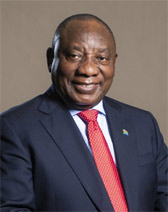
Cyril Ramaphosa
Chief Negotiator of South Africa’s Democratic Transition
Born on November 17, 1952
Age: 74
Profession: Politician, Businessperson
Place of Birth: Johannesburg, South Africa
Cyril Ramaphosa is one of the most prominent political figures to emerge in South Africa’s post-apartheid era. Combining the roles of activist, trade union leader, businessman, and head of state, he gained international recognition primarily for his central role in the negotiations that brought an end to the apartheid regime.
Cyril Ramaphosa was born on November 17, 1952, in Johannesburg, South Africa. He spent his childhood under the oppressive conditions of apartheid, first living in the Transvaal region and later in Soweto, where his family was forcibly relocated. He began his university education in law at the University of the North, where he became actively involved in the Student Christian Movement and the South African Students’ Organisation.
In 1974, Cyril Ramaphosa was arrested for participating in a rally in support of anti-colonial developments in Mozambique and was held in solitary confinement for approximately eleven months. After his release, he continued his anti-apartheid activities. Following the Soweto Uprising of 1976, he was arrested again and released in 1977. He continued his education on a part-time basis and obtained a law degree from the University of South Africa in 1981.
After completing his studies, the trade union movement became decisive in the rise of Cyril Ramaphosa. After working as a legal advisor to the Council of Unions of South Africa, he played a leading role in the founding of the National Union of Mineworkers (NUM) in 1982 and served for many years as its general secretary. In this position, he became known for his efforts to improve the working conditions of Black mineworkers. In 1985, he contributed to the establishment of the Congress of South African Trade Unions (COSATU). In 1987, he led one of the largest strikes in mining history, a turning point that cemented his reputation as a formidable negotiator.
In the early 1990s, as the apartheid regime began to collapse, the African National Congress (ANC), banned since 1960, was legalized once again. In 1991, Cyril Ramaphosa was elected Secretary-General of the ANC and served as the chief negotiator in the talks that paved the way for South Africa’s transition to a multiracial democracy.
In 1994, South Africa held its first non-racial democratic elections, resulting in Nelson Mandela becoming the country’s first Black president. Although Cyril Ramaphosa was widely seen as a leading candidate for the position of deputy president, the role was instead given to Thabo Mbeki. Ramaphosa became a member of the National Assembly and, from 1994 to 1996, chaired the Constitutional Assembly responsible for drafting South Africa’s new constitution. In recognition of this work, he was awarded the Silver Order of the Baobab in 2009. In 1996, he withdrew from active politics, though he retained significant influence within the ANC.
After leaving frontline politics, Cyril Ramaphosa turned to the business sector. Following executive roles at New African Investments Ltd., he founded the diversified investment company Shanduka Group in 2001. With interests spanning mining, finance, real estate, and retail, he soon became one of South Africa’s wealthiest business figures. In 2004, he established the Shanduka Foundation, later renamed the Cyril Ramaphosa Foundation, to promote social and economic development.
In December 2012, Cyril Ramaphosa returned to politics after being elected Deputy President of the ANC at the party’s leadership conference. In 2014, he was appointed Deputy President of South Africa by then-President Jacob Zuma. His election as President of the ANC in December 2017 positioned him as the country’s next head of state. Following Jacob Zuma’s resignation amid corruption scandals, Cyril Ramaphosa was sworn in as President of South Africa on February 15, 2018.
During his presidency, Cyril Ramaphosa confronted major structural challenges, including chronic electricity shortages, economic stagnation, and entrenched corruption. He initiated investigations into corruption within state-owned enterprises and pursued governance reforms. At the same time, internal party pressures pushed him toward more assertive positions on controversial issues such as land reform.
In the 2019 general elections, the ANC retained power despite a decline in its vote share, and Cyril Ramaphosa was re-elected as president. He formed a cabinet based on gender parity, marking a first in South African history. His strict measures during the COVID-19 pandemic initially received public support but later became a source of criticism.
Among the most controversial aspects of Cyril Ramaphosa’s career is his role as a board member of Lonmin during the Marikana mine strike, as well as allegations that emerged in 2022 concerning his Phala Phala farm. Despite these controversies, Cyril Ramaphosa is widely regarded as one of the most significant leaders in South Africa’s post-apartheid political history, closely associated with the principles of reconciliation, negotiation, and reform.
Source: Biyografiler.com
Frequently asked questions about Cyril Ramaphosa
Who is Cyril Ramaphosa?, Cyril Ramaphosa biography, Cyril Ramaphosa life story, Cyril Ramaphosa age, Cyril Ramaphosa facts, Cyril Ramaphosa birthplace, Cyril Ramaphosa photos, Cyril Ramaphosa videos, Cyril Ramaphosa career
Related Biographies

Lamine Yamal
Professional footballer

Sam Altman
Entrepreneur, Investor, CEO

Erling Haaland
Professional footballer

Kylian Mbappe
Professional footballer

Alice Weidel
Politician, Economist

Giorgia Meloni
Politician, Journalist


Hongjoong
Singer, Rapper, Songwriter, Composer

Ludacris
Rapper, Actor

Kwon Eunbi
Singer

Sarah Wayne Callies
Actress, Screenwriter, Producer, Director

LaTavia Roberson
Singer, Actress, Entrepreneur

Sydney Sweeney
Actress

Kevin Warsh
Economist
Lamine Yamal
Professional footballer

Ursula von der Leyen
Politician, Physician

Carl von Clausewitz
Military Commander

Ma Huateng
Entrepreneur, Inventor