
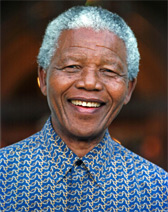
Nelson Mandela
A global symbol of freedom, reconciliation, and human rights
Born on July 18, 1918
Died on December 5, 2013
Age at death: 95
Profession: Politician, Lawyer
Place of Birth: Mvezo village, near Umtata, Transkei, South Africa
Place of Death: Johannesburg, South Africa
Nelson Rolihlahla Mandela was a South African politician, anti-apartheid revolutionary, and freedom fighter who served as the President of South Africa from May 1994 to June 1999. He was the first head of state of South Africa to be elected in a fully representative democratic election and is widely regarded as one of the most admired modern political figures. Mandela was also a recipient of the Nobel Peace Prize.
Nelson Rolihlahla Mandela was born on 18 July 1918 in the village of Mvezo, near Umtata in Transkei, into the Thembu tribe, a Xhosa-speaking community. His father, Gadla Henry Mandela, was a chief of the Thembu people and had four wives, with a total of thirteen children—nine daughters and four sons. Mandela’s mother was Nosekeni Fanny, Gadla’s third wife.
When Rolihlahla Mandela started school at the age of seven, he became the first member of his family to receive formal education. His teacher gave him the English name “Nelson,” after the British admiral Horatio Nelson. At the age of nine, Mandela lost his father to tuberculosis. At sixteen, he enrolled at Clarkebury Boarding Institute, where he completed a three-year Western culture program in just two years. In 1937, at the age of nineteen, he moved to Healdtown and continued his education at Fort Beaufort College. During this period, he became interested in running and boxing.
Later, Mandela enrolled at Fort Hare University, where he began studying Business Administration (BA). It was here that he met Oliver Tambo, who would later become his long-term colleague and close friend. However, Mandela became involved in political activities at the university and was accused of organizing protests between the Student Representative Council and the police. As a result, he was expelled from the institution.
After his expulsion, Nelson Mandela left Transkei and moved to Transvaal, where he worked for a period in the mines as a police officer. During this time, he continued his interrupted university education through correspondence courses. In 1942, he graduated from the University of Witwatersrand’s law faculty and began practicing as a lawyer, becoming the country’s first Black attorney.
In 1944, Mandela joined the African National Congress (ANC - African National Congress), an organization founded by the indigenous population to oppose racial discrimination. In 1948, he became secretary of the ANC Youth League, and in 1950 he was elected its president. These roles positioned him as one of the leading figures in the Black liberation movement. In 1952, Mandela became the ANC Transvaal President and, in the same year, was appointed Deputy National President of the organization. In 1991, he became President of the ANC.
During this period, Mandela also played a key role in the armed struggle against apartheid. In 1961, he helped establish Umkhonto we Sizwe (Spear of the Nation), the military wing of the ANC, and became its leader.
In January 1962, Nelson Mandela traveled abroad to seek international support, visiting the United Kingdom and several African countries. He secured financial and military assistance from African and socialist states. Upon his return, he was arrested and charged with leaving the country without permission, inciting the public, organizing sabotage, and planning assassinations. Mandela argued that laws enacted by a parliament representing only the white minority were illegitimate. In 1962, he was sentenced by the white minority government to five years in prison. On 14 June 1964, he was sentenced to life imprisonment on charges of conspiring to overthrow the South African government.
This conviction transformed Mandela into a global symbol of resistance against racial discrimination. Known as “the world’s most famous prisoner,” he spent 27 years in prison, most of them on Robben Island. During the 1980s, as the global struggle against apartheid intensified, Mandela’s name became known worldwide.
On 2 February 1990, South African President Frederik Willem de Klerk lifted the 30-year ban on the African National Congress and announced a general amnesty. On 11 February 1990, Nelson Mandela was released from prison in Cape Town after 27 years of incarceration. He was 71 years old at the time. His release was celebrated by both Black and white South Africans.
The long struggle of the African National Congress against apartheid reached a decisive milestone on 18 March 1992, when a constitutional reform granting equal citizenship rights to Black South Africans was approved by referendum. The reform had been planned by President De Klerk and marked a turning point in South African history.
Declaring, “The struggle is my life. I will continue fighting for the independence of Black people until the end of my life,” Nelson Mandela dedicated himself to building a democratic South Africa after his release. Over the course of 40 years, he received more than 100 awards. South Africans widely believe that a democratic South Africa would not have been possible without Mandela, whom they regard as a “Freedom Fighter.”
After equal citizenship rights were granted, Mandela won the South African presidential elections and was sworn in on 10 May 1994 as the country’s first Black president.
Mandela received numerous international honors, including the Lenin Peace Prize in 1962, the Nehru Award in 1979, the Bruno Kreisky Human Rights Award in 1981, and UNESCO’s Simon Bolivar Prize in 1983. On 15 October 1993, he was jointly awarded the Nobel Peace Prize with Frederik Willem de Klerk. However, he refused the 1992 Atatürk Peace Prize awarded by the Turkish government, citing allegations of human rights violations by the Turkish state.
After retiring in June 1999, Nelson Mandela continued to advocate for human rights and social justice. He was affectionately known in South Africa by the nickname “Madiba,” given by the elders of his tribe, or “Mkhulu,” meaning “Grandfather,” as many South Africans called him.
Mandela was hospitalized on 8 June 2013 and passed away on 5 December 2013 at his home in Johannesburg, South Africa, at the age of 95.
Marriages:
1st marriage: He married his first wife Evelyn Ntoko Mase in 1944. The couple divorced in 1957 after 13 years of marriage and had three children.
2nd marriage: He married his second wife Winnie Madikizela in 1957. They divorced in 1996.
3rd marriage: In 1998, on his 80th birthday, he married Graça Machel, to whom he remained married until his death.
Source: Biyografiler.com
Frequently asked questions about Nelson Mandela
Who is Nelson Mandela?, Nelson Mandela biography, Nelson Mandela life story, Nelson Mandela age, Nelson Mandela facts, Nelson Mandela birthplace, Nelson Mandela photos, Nelson Mandela videos, Nelson Mandela career

Lamine Yamal
Professional footballer

Kylian Mbappe
Professional footballer

Erling Haaland
Professional footballer

Sam Altman
Entrepreneur, Investor, CEO

Austin Abrams
Actor

Bad Bunny
Rapper, Songwriter


Hongjoong
Singer, Rapper, Songwriter, Composer

Ludacris
Rapper, Actor

Kwon Eunbi
Singer

Sarah Wayne Callies
Actress, Screenwriter, Producer, Director

LaTavia Roberson
Singer, Actress, Entrepreneur

Pedro Sanchez
Politician

Adam Sandler
Actor

Cillian Murphy
Actor
Lamine Yamal
Professional footballer
Austin Abrams
Actor

Brad Pitt
Actor