
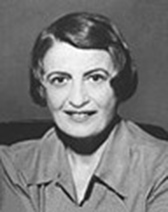
Ayn Rand
Founder of Objectivism and Champion of Radical Individualism
Born on February 2, 1905
Died on March 6, 1982
Age at death: 77
Profession: Novelist, Philosopher, Screenwriter
Place of Birth: St. Petersburg, Russian Empire
Place of Death: New York City, United States
Ayn Rand, born Alissa Zinovievna Rosenbaum, was a Russian-born American writer and philosopher best known as the founder of the philosophy of Objectivism. Through her novels and essays, she articulated a worldview centered on reason, individualism, capitalism, and the moral defense of self-interest.
Ayn Rand was born on February 2, 1905, in St. Petersburg, Russia. She discovered reading at the age of six, and two years later found her first fictional childhood hero in a French magazine. By the age of nine, she had already decided to pursue a career as a novelist. She was strongly opposed to mysticism and collectivism within Russian culture. After discovering the works of Victor Hugo, whom she deeply admired, she began to see herself as a European-style writer.
During her high school years, she witnessed both the 1917 Kerensky Revolution, which she supported, and the Bolshevik Revolution, which she firmly opposed. Seeking refuge from the turmoil, her family relocated to Crimea, where she completed her secondary education. After the establishment of the communist regime, her father’s pharmacy was nationalized, forcing the family into severe poverty and near-starvation. During her high school education, her exposure to American history led her to view the United States as a model country where a free individual could truly live.
After returning from Crimea, she enrolled at Petrograd University to study philosophy and history. As life in her homeland became increasingly oppressive and dull to her, her greatest source of enjoyment became Western films. This interest led her, in 1924, to enroll in a state cinema arts school.
In late 1925, Ayn Rand received permission from Soviet authorities to travel to the United States for a short visit. Although she assured officials that her stay would be temporary, she had already decided never to return to Soviet Russia.
She arrived in New York City in February 1926. After spending six months with relatives in Chicago, she eventually obtained American citizenship in 1931 and moved to Hollywood to pursue a career as a screenwriter.
On her second day in Hollywood, she began her first job after receiving an offer from Cecil B. DeMille. During her first week at the studio, she met actor Frank O’Connor, whom she married in 1929. Their marriage lasted for fifty years.
Years after beginning her studio work, in 1932, she sold her screenplay “Red Pawn” to Universal Pictures. In 1934, she completed her first novel, We the Living. The manuscript was initially rejected by numerous publishers, but in 1936 it was finally published by The Macmillan Company in the United States and Cassell and Company in the United Kingdom.
In 1935, she began writing The Fountainhead. After its completion, the novel was rejected by twelve different publishers. Eventually, Bobbs-Merrill Company published the book in 1943, and it soon became a bestseller.
In 1938, she published Anthem.
In 1942, two film adaptations of We the Living were produced in Rome without her knowledge. These films were censored by the government under Benito Mussolini. Despite the censorship, they were allowed to continue screening for a time due to their anti-Soviet content.
In late 1943, Ayn Rand returned to Hollywood to write the screenplay adaptation of The Fountainhead. Due to World War II, production was delayed until 1948.
In 1946, while working for the Hal Wallis company, she began writing her most ambitious novel, Atlas Shrugged. In 1951, she moved to New York City and devoted herself entirely to completing the book.
Published in 1957, Atlas Shrugged became her greatest literary success. In this novel, she dramatized her unique philosophy of Objectivism in fictional form. Following its success, Ayn Rand continued to write essays on Objectivism and delivered lectures on the subject. From 1962 to 1976, she regularly published her philosophical writings.
After overcoming a battle with cancer, Ayn Rand died of a heart attack on March 6, 1982. She was buried at Kensico Cemetery in New York.
Her books continued to be published and widely read after her death, with total sales approaching twenty million copies worldwide.
Works1934 Night of January 16th
1936 We the Living
1938 Anthem
1943 The Fountainhead
1957 Atlas Shrugged
1961 For the New Intellectual
1964 The Virtue of Selfishness
1966 Capitalism: The Unknown Ideal
1967 Introduction to Objectivist Epistemology
1969 The Romantic Manifesto
1971 The New Left: The Anti-Industrial Revolution
1982 Philosophy: Who Needs It
Source: Biyografiler.com
Frequently asked questions about Ayn Rand
Who is Ayn Rand?, Ayn Rand biography, Ayn Rand life story, Ayn Rand age, Ayn Rand facts, Ayn Rand birthplace, Ayn Rand photos, Ayn Rand videos, Ayn Rand career
Related Biographies

Lamine Yamal
Professional footballer

Kylian Mbappe
Professional footballer

Erling Haaland
Professional footballer

Sam Altman
Entrepreneur, Investor, CEO

Austin Abrams
Actor

Bad Bunny
Rapper, Songwriter


Hongjoong
Singer, Rapper, Songwriter, Composer

Ludacris
Rapper, Actor

Kwon Eunbi
Singer

Sarah Wayne Callies
Actress, Screenwriter, Producer, Director

LaTavia Roberson
Singer, Actress, Entrepreneur

Pedro Sanchez
Politician

Adam Sandler
Actor

Cillian Murphy
Actor
Lamine Yamal
Professional footballer
Austin Abrams
Actor

Brad Pitt
Actor