
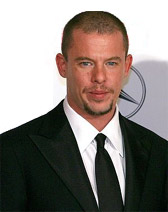
Alexander McQueen
Visionary of Dark Romanticism in Contemporary Fashion
Born on March 17, 1969
Died on February 11, 2010
Age at death: 41
Profession: Fashion Designer
Place of Birth: Lewisham, London, England
Place of Death: Mayfair, London, England
Lee Alexander McQueen was a British fashion designer widely regarded as one of the most influential and provocative figures in modern fashion history. Known for razor-sharp tailoring, theatrical runway presentations, and collections that boldly explored themes of romanticism, sexuality, identity, violence, and mortality, he redefined the boundaries of haute couture. Through both his eponymous label Alexander McQueen and his tenure at Givenchy, he reshaped late 20th- and early 21st-century fashion into a form of conceptual art.
Early Life and Education
Lee Alexander McQueen was born on March 17, 1969, in Lewisham, London, the youngest of six children of Ronald McQueen, a Scottish taxi driver, and Joyce McQueen, a social science teacher. Raised in Stratford in a social housing estate, he displayed an early fascination with clothing design, reportedly sewing dresses for his three sisters as a child. He attended Carpenters Road Primary School and Rokeby School before leaving formal education at sixteen.
Determined to pursue tailoring, he trained on London’s historic Savile Row, apprenticing at Anderson & Sheppard and later at Gieves & Hawkes. There, he mastered traditional bespoke tailoring techniques that would later underpin even his most avant-garde creations. He subsequently worked for theatrical costume specialists Angels and Bermans, then with Japanese designer Koji Tatsuno, and later in Milan for Romeo Gigli. These experiences exposed him to both strict craftsmanship and experimental European aesthetics.
In 1990, despite lacking formal academic qualifications, Lee Alexander McQueen was accepted into the MA Fashion Design program at Central Saint Martins. His 1992 graduate collection, titled “Jack the Ripper Stalks His Victims,” was entirely purchased by influential fashion editor Isabella Blow. Blow became his mentor and champion, encouraging him to use his middle name professionally—thus the emergence of “Alexander McQueen.”
Career Beginnings and Rise to Prominence
In 1992, Lee Alexander McQueen founded his own label, Alexander McQueen, quickly gaining attention for confrontational runway shows. His Autumn/Winter 1993 collection “Taxi Driver” introduced the controversial “bumster” trousers—extremely low-rise pants that reshaped the silhouette of 1990s fashion.
Subsequent collections such as “Nihilism” (Spring/Summer 1994) and “Highland Rape” (Autumn/Winter 1995) cemented his reputation as fashion’s enfant terrible. “Highland Rape,” inspired by historical trauma and Scottish identity, was both fiercely criticized and later reassessed as a powerful commentary on oppression and cultural memory. The collection’s torn fabrics and distressed aesthetics challenged conventional beauty standards and forced audiences to confront discomfort as an artistic device.
Givenchy and International Recognition
In 1996, following the departure of John Galliano, Lee Alexander McQueen was appointed head designer at Givenchy. The role placed him at the helm of a historic French couture house founded by Hubert de Givenchy. While tensions arose between the brand’s classical heritage and McQueen’s rebellious vision, the appointment elevated his international profile.
Simultaneously, he continued building his own label with landmark collections such as “Dante” (1996), “It’s a Jungle Out There” (1997), and the legendary Spring/Summer 1999 show “No. 13.” The finale of “No. 13,” in which robotic arms spray-painted model Shalom Harlow’s white dress live on stage, became one of fashion’s most iconic moments—merging technology, performance art, and couture.
In 2000, the Gucci Group acquired a 51% stake in the Alexander McQueen brand, enabling global expansion into accessories, menswear, eyewear, and fragrance. The diffusion line McQ was later launched to target a younger, edgier audience.
Fashion as Performance Art
Lee Alexander McQueen transformed runway presentations into immersive spectacles. His Spring/Summer 2001 show “Voss” enclosed audiences within mirrored walls, forcing them to confront their own reflections before the performance began. The Autumn/Winter 2006 show “Widows of Culloden” concluded with a holographic illusion of Kate Moss floating ethereally within a glass pyramid.
His final completed collection, Spring/Summer 2010 “Plato’s Atlantis,” explored themes of evolution, environmental catastrophe, and post-human futures. It was the first fashion show to be live-streamed online, signaling a new era in digital fashion presentation. The collection introduced the now-iconic “armadillo” shoes and featured the debut of Lady Gaga’s song “Bad Romance” during the finale.
Collaborations and Cultural Impact
Lee Alexander McQueen collaborated with major cultural figures including David Bowie and Icelandic artist Björk, designing visuals and costumes for her albums “Homogenic” and “Vespertine.” His designs were worn by internationally recognized figures such as Nicole Kidman, Penelope Cruz, Rihanna, and Sarah Jessica Parker.
His influence extended beyond fashion into contemporary art, music, and performance culture. He bridged the gap between couture and conceptual storytelling, often drawing comparisons to artists who blurred disciplinary boundaries.
Personal Life
Lee Alexander McQueen was openly gay and stated that he embraced his identity at a young age. In 2000, he held an unofficial marriage ceremony with documentary filmmaker George Forsyth aboard a yacht in Ibiza. Kate Moss and Annabelle Neilson served as bridesmaids. At the time, same-sex marriage was not legally recognized in Spain. The relationship ended a year later, though they remained close friends.
He later disclosed that he had experienced sexual abuse in childhood and was HIV positive. These personal struggles, combined with intense professional pressure and the recent death of his mother, deeply affected him in his final years.
Death
On February 11, 2010, Lee Alexander McQueen was found dead at his home in Mayfair, London. His death was officially ruled a suicide. He was forty years old and had lost his mother only nine days earlier. The fashion world mourned the loss of one of its most daring and visionary talents.
Legacy
Following his death, longtime collaborator Sarah Burton became creative director of Alexander McQueen, continuing the house’s tradition of technical mastery and dramatic storytelling. Major retrospectives, particularly the exhibition “Alexander McQueen: Savage Beauty,” attracted millions of visitors worldwide and reaffirmed his status as a transformative cultural figure.
In his will, Lee Alexander McQueen allocated £50,000 to ensure his beloved dogs would live in lifelong comfort. He also donated £100,000 each to four charities, including Battersea Dogs & Cats Home and Blue Cross animal welfare organization in Burford, Oxfordshire.
Lee Alexander McQueen remains one of the most revolutionary designers of his generation—an artist who elevated fashion into psychological theater and left an indelible mark on haute couture, performance, and contemporary culture.
Source: Biyografiler.com
Frequently asked questions about Alexander McQueen
Who is Alexander McQueen?, Alexander McQueen biography, Alexander McQueen life story, Alexander McQueen age, Alexander McQueen facts, Alexander McQueen birthplace, Alexander McQueen photos, Alexander McQueen videos, Alexander McQueen career
Related Biographies

Lamine Yamal
Professional footballer

Kylian Mbappe
Professional footballer

Sam Altman
Entrepreneur, Investor, CEO

Erling Haaland
Professional footballer

Alice Weidel
Politician, Economist

Giorgia Meloni
Politician, Journalist


Hongjoong
Singer, Rapper, Songwriter, Composer

Ludacris
Rapper, Actor

Kwon Eunbi
Singer

Sarah Wayne Callies
Actress, Screenwriter, Producer, Director

LaTavia Roberson
Singer, Actress, Entrepreneur
Lamine Yamal
Professional footballer
Erling Haaland
Professional footballer
Kylian Mbappe
Professional footballer

Nicki Minaj
Rapper, Singer, Songwriter, Actress
Giorgia Meloni
Politician, Journalist
Hongjoong
Singer, Rapper, Songwriter, Composer