
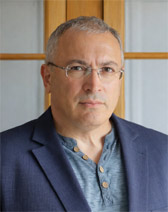
Mikhail Khodorkovsky
From Oil Tycoon to Political Dissident
Born on June 26, 1963
Age: 63
Profession: Businessperson, Political Activist
Place of Birth: Moscow, Russia
Mikhail Khodorkovsky is a Russian businessman, former oligarch, and opposition activist currently living in exile in United Kingdom. Once considered the richest man in Russia, he built his fortune in the 1990s as the head of Yukos oil company. Over time, Mikhail Khodorkovsky became one of the most prominent critics of Vladimir Putin, transforming from a powerful industrialist into a symbol of political resistance in post-Soviet Russia.
Early Life and Education
Mikhail Khodorkovsky was born on June 26, 1963, in Moscow, Russia, to parents Boris and Marina Khodorkovsky, both engineers working in a factory producing measuring equipment. Raised in a technically oriented household, he demonstrated strong academic abilities from an early age.
He studied chemical engineering at the Dmitry Mendeleev University of Chemical Technology of Russia, where he became actively involved in the Komsomol (Communist Youth League). His leadership roles within the organization provided him with early administrative experience and access to influential networks during the late Soviet period.
Entry into Business and Rise During Privatization
During the reforms of Mikhail Gorbachev—notably Glasnost and Perestroika—Mikhail Khodorkovsky entered the emerging private sector. He initially launched small commercial ventures before founding Menatep Bank, which became one of Russia’s first private banks.
In the 1990s, amid the controversial privatization process following the collapse of the Soviet Union, he acquired control of Yukos, one of the country’s largest oil companies. Through aggressive restructuring and adoption of international business practices, he transformed Yukos into a globally competitive energy giant.
Peak Wealth and Influence
By 2003, Mikhail Khodorkovsky had amassed an estimated fortune of around $15 billion, ranking him among the richest individuals in the world according to Forbes. At the height of his power, he was not only a dominant figure in Russia’s oil industry but also an increasingly influential voice in political and economic debates.
In 2001, he founded Open Russia (Open Russia Foundation), aiming to promote civil society, education, and democratic values within the country. This initiative marked the beginning of his more visible engagement in public and political life.
Conflict with the Kremlin and Arrest
Mikhail Khodorkovsky’s growing political influence and criticism of government corruption brought him into direct conflict with Vladimir Putin. In October 2003, he was arrested on charges of fraud and tax evasion, triggering one of the most controversial legal cases in modern Russian history.
Following his arrest, the assets of Yukos were frozen, and the company was eventually dismantled. In 2005, he was convicted and sentenced to nine years in prison. A second trial in 2010 added further charges of embezzlement and money laundering, extending his sentence.
International organizations, including Amnesty International, declared him a “prisoner of conscience,” while the European Court of Human Rights identified procedural violations in his trials. Many observers viewed the prosecutions as politically motivated.
Release and Life in Exile
After nearly a decade in prison, Mikhail Khodorkovsky was pardoned by Vladimir Putin on December 20, 2013. Following his release, he left Russia and initially relocated to Switzerland, before eventually settling in United Kingdom.
In exile, he resumed his political activities, revitalizing the Open Russia movement and advocating for democratic reforms, rule of law, and human rights in Russia. He has since become a frequent speaker on international platforms, addressing issues related to authoritarian governance and political freedoms.
Legacy and Political Significance
Mikhail Khodorkovsky’s life trajectory—from a post-Soviet oligarch to a political prisoner and ultimately an opposition figure—represents one of the most striking transformations in modern Russian history. His story reflects the broader tensions between economic power and political authority in the post-Soviet era.
Today, Mikhail Khodorkovsky remains a prominent critic of the Kremlin and a key voice in discussions about Russia’s political future, standing as a symbol of resistance against centralized power and authoritarianism.
Source: Biyografiler.com
Frequently asked questions about Mikhail Khodorkovsky
Who is Mikhail Khodorkovsky?, Mikhail Khodorkovsky biography, Mikhail Khodorkovsky life story, Mikhail Khodorkovsky age, Mikhail Khodorkovsky facts, Mikhail Khodorkovsky birthplace, Mikhail Khodorkovsky photos, Mikhail Khodorkovsky videos, Mikhail Khodorkovsky career
Related Biographies

Lamine Yamal
Professional footballer

Sam Altman
Entrepreneur, Investor, CEO

Erling Haaland
Professional footballer

Kylian Mbappe
Professional footballer

Alice Weidel
Politician, Economist

Giorgia Meloni
Politician, Journalist


Hongjoong
Singer, Rapper, Songwriter, Composer

Ludacris
Rapper, Actor

Kwon Eunbi
Singer

Sarah Wayne Callies
Actress, Screenwriter, Producer, Director

LaTavia Roberson
Singer, Actress, Entrepreneur

Keanu Reeves
Actor

Eva Mendes
Actress, Model
Lamine Yamal
Professional footballer

Sydney Sweeney
Actress

Andrew Garfield
Actor
Kylian Mbappe
Professional footballer