
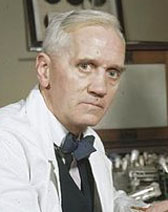
Alexander Fleming
The Man Who Changed the Fate of Medicine
Born on August 6, 1881
Died on March 11, 1955
Age at death: 74
Profession: Bacteriologist
Place of Birth: Lochfield, Darvel, Scotland
Place of Death: London, England
Alexander Fleming was a Scottish bacteriologist whose discovery of penicillin transformed modern medicine and permanently changed humanity’s relationship with antibiotics. His groundbreaking work saved millions of lives and laid the foundation for the treatment of bacterial infections that were once considered fatal.
Alexander Fleming was born on August 6, 1881, in Lochfield, Darvel, Scotland, as one of eight children. His father died when Fleming was only seven years old. He was educated at Louden Moor School, Darvel School, and later spent two years at an academy in Kilmarnock. Before entering medical school, Fleming worked for four years at a maritime shipping office. In 1901, he enrolled at St. Mary’s Hospital Medical School in Paddington and studied at the University of London. He graduated in 1906 and completed his postgraduate studies in 1908 with a thesis on acute bacterial infections, earning a distinction for outstanding academic achievement.
Until the outbreak of World War I, Fleming served at St. Mary’s Hospital in London, where he worked under one of the pioneers of vaccine therapy, Sir Almroth Edward Wright. Fleming would remain affiliated with St. Mary’s throughout his life, initially as a student and later as a faculty member. In 1921, he was promoted from assistant to deputy of Wright, and in 1928, he became Professor of Bacteriology. In 1946, he assumed leadership of the Vaccine Institute after it gained institutional status. Although he retired from his teaching position at the University of London in 1948, he continued his work at the institute.
Between 1914 and 1918, during World War I, Fleming served as a medical officer with the rank of captain and worked on the front lines. There, he witnessed soldiers dying in horrifying numbers due to infections rather than wounds. After the war, he returned to St. Mary’s Hospital and focused his research on antiseptics, while also teaching bacteriology. In 1921, after years of research, he discovered the antibacterial enzyme lysozyme.
Alexander Fleming made both of his major discoveries largely by chance during the 1920s. The first, lysozyme, was discovered when he accidentally sneezed into a Petri dish containing bacteria. Days later, he noticed that the bacteria in contact with mucus had been destroyed.
In September 1928, while working with cultures of *Staphylococcus aureus*, Fleming noticed that one of the culture plates—left exposed to laboratory air for several days—had become contaminated with mold. Around the mold, the bacteria had failed to grow. Upon closer examination, he realized that the mold was destroying potentially harmful bacteria. He identified the mold as a species of *Penicillium* and named the antibacterial substance it produced “penicillin.” In 1929, he published his findings, demonstrating that penicillin was non-toxic and inhibited the growth of many dangerous bacteria.
Fleming often worked with garden soil, which made his research especially difficult, as isolating and cultivating the correct molds was a labor-intensive process. Fleming himself did not advance the discovery further. The development of penicillin into a usable drug was accomplished by Howard Florey and Ernst Boris Chain, whose work led to the mass production of penicillin. Thanks to their efforts, countless lives were saved during and after World War II.
In 1943, Fleming was elected a member of the Royal Society. In 1944, he was knighted and received the John Scott Medal. In 1945, he shared the Nobel Prize in Physiology or Medicine with Howard Florey and Ernst Boris Chain. Twelve years after Fleming’s initial discovery, Florey and Chain succeeded in producing penicillin in sufficient quantities for clinical trials.
Alexander Fleming married Sarah Marion McElroy in 1915 in Killala, Ireland. The couple had one son. After Sarah’s death in 1949, Fleming remarried in 1953 to his Greek colleague Dr. Amalia Koutsouri-Voureka.
Alexander Fleming died on March 11, 1955, in London, England, at the age of seventy-four, as a result of a heart attack.
**Awards:**
1945 – Nobel Prize in Physiology or Medicine
1944 – Knighted and awarded the John Scott Medal
**The Remarkable Story of Alexander Fleming**
An English couple once traveled to the vast countryside of Scotland with their young son to spend a summer holiday immersed in nature. One day, the young man wandered alone near a grove by the village and, drawn by a pool of water, decided to swim. Suddenly, he was struck by intense cramps and began to drown, losing strength with each passing moment.
A local farmer’s son, working nearby, heard the desperate cries and rushed to the scene. Seeing the stranger struggling in the water, he immediately jumped in and saved the young man from drowning.
The rescued boy’s father later invited the courageous young farmer to his home to express his gratitude. During their conversation, he asked about the young man’s plans for the future. Reluctantly, the boy replied that he would become a farmer like his father.
“I would have liked to become a doctor,” the young Scot said quietly, “but we are poor people. My father cannot afford such an education.”
“Do not worry,” replied the English father. “Your wish will come true. I will pay for all your medical education.”
Many years later, in December 1943, Winston Churchill fell gravely ill in North Africa. The diagnosis was severe pneumonia, a disease that was often fatal at the time. A message was sent immediately to the man who had discovered the miraculous drug known as penicillin—Sir Alexander Fleming.
Fleming flew from England to Africa and personally administered the drug to the British Prime Minister. Pneumonia, once a death sentence, failed to claim Churchill’s life. Penicillin worked swiftly, and Fleming saved Churchill’s life.
For the second time.
The young Scot who had once rescued Churchill from drowning in a small Scottish lake—and who had been educated through the generosity of Churchill’s father—was none other than Dr. Alexander Fleming.
Source: Biyografiler.com
Frequently asked questions about Alexander Fleming
Who is Alexander Fleming?, Alexander Fleming biography, Alexander Fleming life story, Alexander Fleming age, Alexander Fleming facts, Alexander Fleming birthplace, Alexander Fleming photos, Alexander Fleming videos, Alexander Fleming career
Related Biographies

Lamine Yamal
Professional footballer

Kylian Mbappe
Professional footballer

Erling Haaland
Professional footballer

Sam Altman
Entrepreneur, Investor, CEO

Austin Abrams
Actor

Bad Bunny
Rapper, Songwriter


Hongjoong
Singer, Rapper, Songwriter, Composer

Ludacris
Rapper, Actor

Kwon Eunbi
Singer

Sarah Wayne Callies
Actress, Screenwriter, Producer, Director

LaTavia Roberson
Singer, Actress, Entrepreneur

Pedro Sanchez
Politician

Adam Sandler
Actor

Cillian Murphy
Actor
Lamine Yamal
Professional footballer
Austin Abrams
Actor

Brad Pitt
Actor