
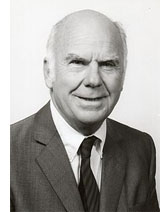
Albert S. Humphrey
American management consultant associated with the development of SWOT analysis at Stanford Research Institute and known for his work in strategic planning, organizational management, and cultural change.
Born on May 2, 1926
Died on October 31, 2005
Age at death: 79
Profession: Consultant
Place of Birth: Kansas City, Missouri, United States
Place of Death: England, United Kingdom
Albert S. Humphrey (June 2, 1926 – October 31, 2005) was an American business and management consultant specializing in organizational development, strategic planning, and cultural change. He is frequently credited with developing SWOT Analysis, a management technique used to evaluate an organization's strengths, weaknesses, opportunities, and threats. However, historical research published in 2023 and 2024 established that the technique developed from the earlier SOFT framework created by a research team at the Stanford Research Institute (SRI) under the leadership of Robert Franklin Stewart. Humphrey participated in this research and subsequently developed management consulting methods associated with organizational planning and implementation. During his career, he advised more than 100 companies internationally and later established his professional activities in London.
Early Life and Education
Albert S. Humphrey was born on June 2, 1926, in Kansas City, Missouri, United States.
He studied chemical engineering at the University of Illinois, graduating with a Bachelor of Science degree in 1946.
He continued his education at the Massachusetts Institute of Technology (MIT), where he obtained a master's degree in chemical engineering in 1948.
In 1955, Humphrey completed a Master of Business Administration (MBA) at Harvard Business School. His education combined engineering, quantitative analysis, and business administration, fields that later informed his work in organizational planning and management consulting.
Career at Stanford Research Institute
In January 1965, Albert S. Humphrey joined the Stanford Research Institute, an independent research organization in California that later became known as SRI International.
He worked on corporate planning and organizational management projects intended to help companies evaluate their performance, identify difficulties, and implement strategic decisions.
During the 1960s, SRI researchers examined the effectiveness of long-range corporate planning and developed methods for involving management teams in organizational decision-making.
Humphrey participated in work associated with the institute's Theory and Practice of Planning group, led by Robert Franklin Stewart.
The research contributed to the development of structured planning methods, including the SOFT framework, which preceded modern SWOT analysis.
Humphrey left SRI in June 1969 and continued his career as an independent management consultant.
Contribution to SWOT Analysis
Albert S. Humphrey is closely associated with the development of SWOT Analysis, one of the established methods used in strategic business planning.
The technique evaluates internal organizational characteristics alongside external environmental conditions.
Its four components are:
Strengths: Internal capabilities, resources, skills, and advantages that support an organization's objectives.
Weaknesses: Internal limitations, insufficient resources, operational problems, or other factors that may reduce organizational effectiveness.
Opportunities: External developments or circumstances that an organization could use to improve its position or achieve specific goals.
Threats: External risks, competitive pressures, economic changes, or other conditions that could negatively affect the organization.
SWOT analysis is generally presented as a four-part matrix that allows managers to examine these factors together before making strategic decisions.
The technique is used in corporate planning, market-entry assessments, organizational restructuring, project management, and human resources.
Origins of the SOFT Framework
Before the widespread adoption of SWOT, researchers at the Stanford Research Institute developed a planning approach known as SOFT.
The original framework used the categories Satisfactory, Opportunity, Fault, and Threat.
SOFT:
S – Satisfactory: Positive conditions in the present
O – Opportunity: Positive possibilities in the future
F – Fault: Negative conditions in the present
T – Threat: Negative possibilities in the future
The framework was presented in a 1965 SRI report associated with Robert Franklin Stewart and his research colleagues.
The terminology subsequently evolved into Strengths, Weaknesses, Opportunities, and Threats, producing the SWOT acronym.
Albert S. Humphrey described this development in a paper titled SWOT Analysis for Management Consulting, published in the SRI Alumni Newsletter in December 2005, shortly after his death.
Although numerous business publications have identified Humphrey as the inventor of SWOT analysis, archival research published in Long Range Planning in 2023 and the Journal of Management History in 2024 attributed the original SOFT framework primarily to Stewart and the SRI research team.
Humphrey's documented involvement was therefore part of a broader research and consulting effort rather than the independently established invention of the entire method.
Management Consulting and Team Action Management
After leaving the Stanford Research Institute, Albert S. Humphrey developed a career advising organizations on business planning, management processes, and cultural change.
He worked with more than 100 companies internationally, helping management teams establish objectives, identify organizational problems, and improve the implementation of strategic decisions.
He was also associated with Team Action Management (TAM), a management approach emphasizing participation, coordinated planning, and clearly defined responsibilities.
Humphrey described the relationship between strategic planning and organizational action as a central concern of his consulting work. He emphasized that identifying problems was insufficient unless management teams agreed on practical measures to address them.
His consulting activities included management training, corporate planning seminars, and organizational development projects.
He eventually moved to London, where he continued working with British and international organizations.
International Consulting Activities
Throughout his consulting career, Albert S. Humphrey worked with companies and public-sector organizations in different countries.
In 2004, he participated in an international management seminar in Greece associated with the consulting firm PricewaterhouseCoopers (PwC).
Accounts of his professional activities also describe meetings and private sessions involving senior Greek government officials, including the prime minister.
His consulting work concentrated on organizational performance, leadership, strategic planning, and the management of institutional change.
By the final years of his career, he had been included in professional directories such as Who's Who in the World, Debrett's People of Today, and Who's Who in Science and Engineering.
Applications of SWOT Analysis
SWOT analysis is used by businesses and organizations to evaluate their current position and identify possible courses of action.
Strategic Planning: Organizations examine their internal capabilities and external environment before developing or revising strategic plans.
Market Entry: Companies assess available resources, competitive conditions, commercial opportunities, and potential risks when entering a new market.
Business Development: Management teams identify operational strengths and weaknesses before deciding how to expand or improve their activities.
Human Resources: SWOT can be adapted to employee development, career planning, recruitment, and performance management. It may help identify professional strengths and development needs, although it does not replace validated employee assessment methods.
Problem Identification: Teams use the framework to organize factors affecting a specific problem and consider possible solutions.
SWOT is sometimes discussed alongside the TOWS Matrix, a related approach used to formulate strategies by combining internal strengths and weaknesses with external opportunities and threats.
Although the two methods use similar categories, the TOWS Matrix places greater emphasis on developing strategic alternatives from the relationships among those factors.
Personal Life
Albert S. Humphrey was married to Virginia P. Humphrey, with whom he had four children. The marriage subsequently ended in divorce.
After moving to London, he married Myriam de Baere. Biographical accounts also identify a daughter from this relationship.
Humphrey continued living and working in England during the later years of his life.
Death
Albert S. Humphrey died on October 31, 2005, in England, at the age of 79.
His death was recorded in a University of Illinois alumni publication, which also documented his education and service at the Stanford Research Institute.
Selected Publications and Professional Contributions
1960s – Research and consulting work on corporate planning at the Stanford Research Institute
1965 – Participation in the research environment associated with the SOFT strategic planning framework
1969 – Transition to independent management consulting
1970s–2000s – Development and application of Team Action Management methods
2004 – Participation in an international management seminar in Greece
2005 – SWOT Analysis for Management Consulting (SRI Alumni Newsletter, December 2005)
Source: Biyografiler.com
Frequently asked questions about Albert S. Humphrey
Who is Albert S. Humphrey?, Albert S. Humphrey biography, Albert S. Humphrey life story, Albert S. Humphrey age, Albert S. Humphrey facts, Albert S. Humphrey birthplace, Albert S. Humphrey photos, Albert S. Humphrey videos, Albert S. Humphrey career

Lamine Yamal
Professional footballer

Brad Pitt
Actor

Erling Haaland
Professional footballer

Kylian Mbappe
Professional footballer

Leonardo DiCaprio
Actor

Sam Altman
Entrepreneur, Investor, CEO

Michael Bay
Film Director, Producer

Michael Ballack
Former Professional Footballer

Mia Wasikowska
Actress

Michael Emerson
Actor

Mikhail Gorbachev
Politician, Head of State

Mesut Barzani
Politician
Lamine Yamal
Professional footballer

Taylor Swift
Singer, Musician, Songwriter

Erling Haaland
Professional footballer
Sam Altman
Entrepreneur, Investor, CEO

Acun Ilıcalı
Producer, TV Personality, Media executive, Businessperson