
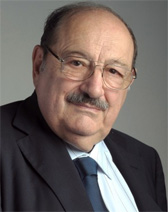
Umberto Eco
Born on January 5, 1932
Died on February 19, 2016
Age at death: 84
Profession: Literary Critic, Academic, Journalist, Novelist, Philosopher
Place of Birth: Alessandria, Piedmont, Italy
Place of Death: Milan, Italy
One of the most influential intellectuals of the modern age; a master of semiotics and medieval thought
Umberto Eco was an Italian literary critic, academic, journalist, semiotician, novelist, and modern philosopher. He became internationally famous with his intellectually demanding detective novel The Name of the Rose (1980), which introduced complex semiotic theory, medieval theology, and philosophical inquiry to a wide readership. Eco argued that semiotics could function as a unifying discipline capable of explaining medieval doctrines, biblical exegesis, literary theory, and fictional mysteries. He is widely recognized for transforming everyday cultural phenomena into systems of signs and constructing them as a coherent theoretical doctrine. A leading medievalist, Eco spoke five languages at a near-native level.
Umberto Eco, also known in intellectual circles by the pseudonym “Dedalus,” was born on 5 January 1932 in the small Italian town of Alessandria. His father Giulio was an accountant who was drafted into military service during the war, after which Eco and his mother Giovanna relocated to a rural town at the foothills of the Piedmontese mountains. During this period, Eco observed the ideological conflict between fascists and partisans with a calm but deeply attentive mind. These early experiences later formed the conceptual foundation of his second novel Foucault’s Pendulum.
Despite his father’s wish that he become a lawyer, Eco abandoned legal studies and followed his intellectual passions by enrolling at the University of Turin, where he studied Medieval Philosophy and Literature. In 1954, he completed his doctorate with a thesis on the aesthetic theory of Thomas Aquinas, focusing on medieval scholasticism. Deeply influenced by his mentor Luigi Pareyson, Eco wrote a critical analysis of Pareyson’s work Estetica per Lettere Italiane. During his early years, Eco was an intellectually militant Catholic, but after completing his doctorate, he questioned religious belief and ultimately left the Roman Catholic Church.
Between 1954 and 1959, Eco worked in Milan as a cultural editor for the Italian state television broadcaster RAI. This role allowed him to critique modern culture through the lens of mass media while simultaneously developing his professional writing career. In 1956, he published his first book The Aesthetic Problem of Thomas Aquinas, an expanded version of his doctoral thesis. Around the same time, he began lecturing at conferences organized by the University of Turin and helped establish intellectual networks among avant-garde writers, musicians, and artists.
After completing his military service in 1959, Eco wrote his second book on medieval aesthetics, The Development of Medieval Aesthetics, but lost his position at RAI. Paradoxically, this setback marked the beginning of his most productive intellectual period. That same year, he became a senior editor at Casa Editrice Bompiani in Milan and began writing a monthly column titled Diario Minimo for the intellectual magazine Il Verri. These essays, later collected as Misreadings, humorously and critically examined popular culture through linguistic and semiotic frameworks.
Throughout the 1950s and early 1960s, Eco developed his ideas on meaning, aesthetics, and communication. In 1962, he published one of his most influential theoretical works, The Open Work, which examined modernity through its traditional roots and challenged rigid interpretations of art. In the same year, he married German art educator Renate Ramge.
Eco’s essays appeared regularly in major Italian newspapers and journals such as La Stampa, Corriere della Sera, La Repubblica, L’Espresso, and Il Manifesto. In 1964, he accepted a position as Professor of Visual Communication at the University of Florence, later becoming Professor of Semiotics at the Milan Polytechnic in 1966. His growing interest in semiotics culminated in the publication of The Absent Structure (1968), followed by his landmark theoretical synthesis A Theory of Semiotics (1976).
In 1971, Eco joined the University of Bologna as Professor of Semiotics, where he continued refining his theories on signs and interpretation. Throughout the 1970s, he published numerous essays and books, including A Semiotic Landscape, which emerged from a conference he organized for the International Association for Semiotic Studies.
Eco made an unexpected yet transformative shift to fiction with the publication of The Name of the Rose in 1980. Combining medieval history, semiotics, theology, and detective fiction, the novel became a worldwide phenomenon, selling millions of copies and redefining the possibilities of the intellectual novel. The book was later adapted into a film in 1986 by Jean-Jacques Annaud, starring Sean Connery.
Following this success, Eco continued both his academic and literary careers. His novels Foucault’s Pendulum, The Island of the Day Before, Baudolino, and The Mysterious Flame of Queen Loana further explored historical memory, irrational belief systems, and the nature of interpretation. In parallel, he published major academic works such as Semiotics and the Philosophy of Language and The Limits of Interpretation.
Eco received numerous international awards and honors, including the Strega, Viareggio, Médicis, McLuhan Teleglobe, and Anghiari prizes, as well as state decorations from Italy, France, and Germany. He maintained a personal library of over 30,000 volumes in his Milan home, continued teaching at the University of Bologna, and wrote weekly columns for L’Espresso.
Umberto Eco passed away on 19 February 2016 in Milan at the age of 84 after a long battle with cancer. He left behind a legacy that permanently reshaped literary theory, semiotics, and the intellectual novel, bridging the medieval and the modern with unmatched depth and clarity.
Source: Biyografiler.com
Frequently asked questions about Umberto Eco
Who is Umberto Eco?, Umberto Eco biography, Umberto Eco life story, Umberto Eco age, Umberto Eco facts, Umberto Eco birthplace, Umberto Eco photos, Umberto Eco videos, Umberto Eco career
Related Biographies

Lamine Yamal
Professional footballer

Erling Haaland
Professional footballer

Kylian Mbappe
Professional footballer

Austin Abrams
Actor

Bad Bunny
Rapper, Songwriter

Sam Altman
Entrepreneur, Investor, CEO


Hongjoong
Singer, Rapper, Songwriter, Composer

Ludacris
Rapper, Actor

Kwon Eunbi
Singer

Sarah Wayne Callies
Actress, Screenwriter, Producer, Director

LaTavia Roberson
Singer, Actress, Entrepreneur

Amber Heard
Actress, Model
Lamine Yamal
Professional footballer
Bad Bunny
Rapper, Songwriter
Erling Haaland
Professional footballer
Kylian Mbappe
Professional footballer
Austin Abrams
Actor