
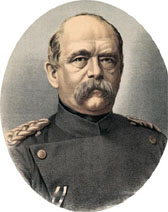
Otto von Bismarck
The Iron Chancellor – Architect of German Unity
Born on April 1, 1815
Died on July 30, 1898
Age at death: 83
Profession: Statesman, Politician, Diplomat
Place of Birth: Prussia (Kingdom of Prussia)
Place of Death: Friedrichsruh, Germany
Otto von Bismarck was the German statesman who played the decisive role in transforming Germany into a powerful empire and became its first Chancellor (Prime Minister). He was the politician who successfully achieved German unification, reshaping the political balance of Europe in the nineteenth century.
Otto von Bismarck was born on 1 April 1815 into an aristocratic family in Prussia. His full name was Otto Eduard Leopold von Bismarck-Schönhausen. After completing his secondary education in Berlin, he studied law at the University of Göttingen. At the time, Prussia was the largest of the many German principalities that ruled the lands of what would later become modern Germany. Under Bismarck’s leadership, Germany transformed from a loose collection of small and weak states into one of Europe’s most powerful military nations.
Otto von Bismarck began his professional life as a civil servant but soon resigned, believing the career was not suited to him. He then managed his father’s estates for a period before marrying. After embracing Lutheranism, his life and worldview began to change significantly. Physically strong and imposing, Bismarck spent much of his leisure time hunting and horseback riding.
In 1847, Otto von Bismarck was elected to the Prussian Parliament, where he gained a reputation as a hardline right-wing supporter of the monarchy. He aligned himself closely with King Frederick William IV and later with his successor Wilhelm I (Kaiser Wilhelm I). Bismarck subsequently served as ambassador to France and Russia. On 22 September 1862, he was appointed Prime Minister of Prussia. In his first parliamentary speech, he famously declared that the great issues of the time would be resolved by “blood and iron.”
Bismarck’s primary objectives were to protect the king, strengthen the army, and promote national unity. Although many Germans supported the idea of unification, the individual German states were reluctant to surrender their independence. Otto von Bismarck resolved this by using Prussia’s military power to persuade weaker states to join a new federation. During the 1860s, Prussia annexed Hanover, Frankfurt, and several other small German principalities.
The final step toward unification came with the outbreak of the Franco-Prussian War in 1870. The conflict ended after French Emperor Napoleon III was captured at the Battle of Sedan on 2 September 1870. This decisive victory encouraged the remaining German states to unite under Prussian leadership. Following France’s defeat, Kaiser Wilhelm I was proclaimed German Emperor in 1871, and on 21 March 1871, Otto von Bismarck was declared the first Chancellor of the German Federation.
As Chancellor, Otto von Bismarck sought to secure peace in Europe, believing stability was essential for the newly unified Germany to strengthen itself economically and militarily. He became known for his cautious foreign policy, often described as realpolitik, which emphasized balance of power over ideology. Domestically, he pursued significant reforms, including the introduction of one of the world’s first social security systems in 1889. This system later served as an inspiration for social security programs in the United States.
In March 1878, when peace negotiations between the Ottoman Empire and Russia reached an impasse, Otto von Bismarck assumed the role of mediator. He organized and presided over the Congress of Berlin, which sought to stabilize the Balkans and redefine regional power relations.
A Junker himself, meaning a large landowning aristocrat, Otto von Bismarck gradually adopted a more conservative stance in domestic politics. To address budget deficits caused largely by military expenditures, he attempted to introduce new taxes. When parliament resisted, he dissolved it, using an assassination attempt against Kaiser Wilhelm I as justification.
Between 1870 and 1900, Germany faced a prolonged economic slowdown whose causes remain debated. To combat this downturn, Otto von Bismarck raised customs tariffs and adopted a protectionist trade policy. This approach earned him support from both large landowners and industrialists.
After the death of Kaiser Wilhelm I, Bismarck’s political influence declined during the reign of his grandson Wilhelm II. The new emperor favored a more aggressive foreign policy, which conflicted with Bismarck’s cautious approach. On 20 March 1890, Otto von Bismarck was forced to resign from office.
Otto von Bismarck married Johanna von Puttkamer in 1847. She died in 1894. He adopted her Lutheran faith, a change that also influenced his political and moral outlook.
Otto von Bismarck died on 30 July 1898 in Friedrichsruh, Germany, at the age of 83.
His legacy extended far beyond his lifetime. One of Germany’s most important battleships during the Second World War was named Bismarck and was sunk by British forces in 1940 after a two-day battle. The capital city of the U.S. state of North Dakota has borne the name Bismarck since 1873. During Bismarck’s era, Germany also acquired its first African colonies, including territories that are today independent states such as Cameroon, Namibia, and Tanzania.
Source: Biyografiler.com
Frequently asked questions about Otto von Bismarck
Who is Otto von Bismarck?, Otto von Bismarck biography, Otto von Bismarck life story, Otto von Bismarck age, Otto von Bismarck facts, Otto von Bismarck birthplace, Otto von Bismarck photos, Otto von Bismarck videos, Otto von Bismarck career
Related Biographies

Lamine Yamal
Professional footballer

Erling Haaland
Professional footballer

Kylian Mbappe
Professional footballer

Austin Abrams
Actor

Bad Bunny
Rapper, Songwriter

Sam Altman
Entrepreneur, Investor, CEO


Hongjoong
Singer, Rapper, Songwriter, Composer

Ludacris
Rapper, Actor

Kwon Eunbi
Singer

Sarah Wayne Callies
Actress, Screenwriter, Producer, Director

LaTavia Roberson
Singer, Actress, Entrepreneur
Bad Bunny
Rapper, Songwriter

Margot Robbie
Actress
Kylian Mbappe
Professional footballer

Neymar
Professional footballer

Pedro Sanchez
Politician

Ronaldinho
Professional footballer