
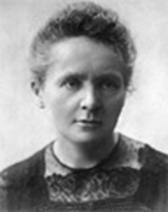
Marie Curie
Born on November 7, 1867
Died on July 4, 1934
Age at death: 67
Profession: Physicist, Chemist
Place of Birth: Warsaw, Poland
Place of Death: Sancellemoz Sanatorium, Savoy, France
Marie Curie, born as Maria (Manya) Skłodowska and also known as Madam Curie, was a Polish-born French physicist and chemist. She was the founder of the science of radiology and one of the pioneers of radioactivity. Curie was awarded the Nobel Prize in Physics in 1903 and the Nobel Prize in Chemistry in 1911, becoming the first person in history to receive two Nobel Prizes.
Born on November 7, 1867, in Warsaw, Poland, Marie Curie received her early education from her sister Bronya Skłodowska and her parents, both of whom were teachers. She graduated from high school as the top student at the age of 15. However, due to restrictions under Russian rule in Warsaw that prevented women from entering university, she worked for several years as a governess. In 1891, with the encouragement of her sister Bronya Skłodowska, who was studying medicine at the Sorbonne in Paris, she moved to Paris. There, she attended lectures by Paul Appell, Gabriel Lippmann, and Edmond Bouty, and met leading scientists of the era such as Jean Perrin, Charles Maurain, and Aimé Cotton.
Despite living in poverty during her first years in Paris, Curie graduated first in her class with a degree in physics and began working in Gabriel Lippmann’s research laboratory. In 1894, she earned a second degree in mathematics. That same year, she met Pierre Curie, a physicist known for co-discovering piezoelectricity with his brother Jacques Curie. Sharing similar scientific interests, they developed a close relationship and married on July 25, 1895. From that point on, she adopted the name Marie Curie instead of Maria Skłodowska.
After obtaining her teaching certificate in 1896, Curie began investigating the radiation emitted by uranium salts, a phenomenon first reported by Henri Becquerel. Her research was briefly interrupted by the birth of her first daughter, Irène Curie, in September 1897. In early 1898, she resumed her work and discovered that thorium also emitted similar radiation. Following this discovery, Pierre Curie set aside his own research to assist her.
In July 1898, the Curie couple announced the discovery of a new radioactive element, polonium, named after Marie’s homeland. In September of the same year, they announced the discovery of radium, which was identified with the help of spectroscopy by French chemist Eugène Demarçay.
In June 1903, Marie Curie completed her doctoral thesis, becoming the first woman in France to earn a doctorate in advanced scientific research. That same year, she and Pierre Curie received the Royal Davy Medal and shared the Nobel Prize in Physics with Henri Becquerel, making Marie Curie the first woman to win a Nobel Prize.
In 1904, while Pierre Curie began teaching at the Sorbonne, Marie taught physics at a girls’ school in Sèvres. Later that year, their second daughter, Ève Curie, was born. During this period, the harmful effects of radiation exposure became increasingly evident, and scientists began to understand the damage radium could cause to human tissue. This realization eventually led to the idea of using radium therapeutically to treat malignant tissues. Inventor Alexander Graham Bell even proposed applying radium directly to tumors for cancer treatment.
On April 19, 1906, Pierre Curie died tragically after being struck by a horse-drawn carriage. Widowed with two children, Marie Curie was appointed on May 13 of the same year to the professorship left vacant by her husband, becoming the first female professor at the Sorbonne. In 1908, she continued her academic work while distancing herself from administrative duties, and in 1910 published one of her most significant works on radioactivity.
In 1911, in Stockholm, Sweden, Curie was awarded the Nobel Prize in Chemistry for her discovery of pure radium and polonium and for her contributions to the study of these elements. In her acceptance speech, she acknowledged Pierre Curie’s assistance while emphasizing that the hypothesis that radioactivity was an atomic property originated from her own research.
Despite her achievements, Curie faced personal attacks and discrimination. She was denied membership in the French Academy of Sciences by a single vote, largely because it was composed entirely of men. Another controversy involved rumors of a romantic relationship with physicist Paul Langevin, a married man and former friend of Pierre Curie. The so-called “Langevin scandal” was widely covered in newspapers and overshadowed even her second Nobel Prize. Although Langevin later challenged the newspaper editor to a public debate, which the editor declined, the incident deeply affected Curie and led to a period of psychological distress.
In 1914, Curie was appointed the first director of the Radium Institute at the University of Paris. During World War I, she worked alongside her daughter Irène Curie—who would later receive the Nobel Prize in Chemistry in 1935—to train young women in X-ray technology and instruct medical professionals in the use of radiological equipment on the battlefield.
Throughout the 1920s, Curie continued her scientific work and played a key role in establishing the Radium Institute in Warsaw. In 1921, she traveled to the United States with her two daughters, where President Herbert Hoover presented her with a $50,000 award, which she used to purchase radium for the newly founded Warsaw laboratory.
Curie delivered lectures in Belgium, Brazil, Spain, and Czechoslovakia, and was elected a member of the International Committee on Intellectual Cooperation of the League of Nations. She also witnessed the development of the Curie Foundation in Paris and the opening of another Radium Institute in 1932, whose directorship was entrusted to her sister.
Marie Curie died on July 4, 1934, from leukemia at the Sancellemoz Sanatorium in Savoy, France. Her illness was later attributed to prolonged exposure to high levels of radiation. For this reason, she became known as “the woman who died for science,” and her name was given to the unit of radioactivity, the curie.
Source: Biyografiler.com
Frequently asked questions about Marie Curie
Who is Marie Curie?, Marie Curie biography, Marie Curie life story, Marie Curie age, Marie Curie facts, Marie Curie birthplace, Marie Curie photos, Marie Curie videos, Marie Curie career

Lamine Yamal
Professional footballer

Kylian Mbappe
Professional footballer

Erling Haaland
Professional footballer

Sam Altman
Entrepreneur, Investor, CEO

Austin Abrams
Actor

Bad Bunny
Rapper, Songwriter


Hongjoong
Singer, Rapper, Songwriter, Composer

Ludacris
Rapper, Actor

Kwon Eunbi
Singer

Sarah Wayne Callies
Actress, Screenwriter, Producer, Director

LaTavia Roberson
Singer, Actress, Entrepreneur

Adam Sandler
Actor

Cillian Murphy
Actor

Pedro Sanchez
Politician
Lamine Yamal
Professional footballer
Austin Abrams
Actor

Brad Pitt
Actor