
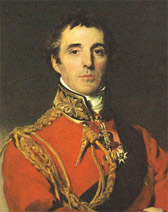
Lord Wellington
The 1st Duke of Wellington, British field marshal and prime minister who commanded the Allied army against Napoleon Bonaparte at the Battle of Waterloo in 1815.
Born on May 1, 1769
Died on September 14, 1852
Age at death: 83
Profession: Military Commander, Politician, Former Prime Minister
Place of Birth: Dublin, Ireland
Place of Death: Walmer Castle, Kent, England
Lord Wellington, born Arthur Wellesley and formally known as the 1st Duke of Wellington, was a British military commander and statesman who defeated Napoleon Bonaparte at the Battle of Waterloo on June 18, 1815, with the assistance of Prussian forces commanded by Gebhard Leberecht von Blücher. He previously commanded British and Allied armies during the Peninsular War and served as Prime Minister of the United Kingdom from 1828 to 1830 and briefly in 1834. His military career extended from campaigns in India to the Napoleonic Wars, while his political career included the passage of the Roman Catholic Relief Act of 1829 and opposition to parliamentary reform.
Early Life and Education
Lord Wellington was born Arthur Wesley on May 1, 1769, in Dublin, Ireland, into an aristocratic Anglo-Irish Protestant family. His father, Garret Wesley, was the 1st Earl of Mornington, and his mother, Anne Hill-Trevor, was the daughter of the 1st Viscount Dungannon. The family owned estates in Ireland and maintained connections with the Irish political establishment.
He attended Eton College in England between 1781 and 1784. Following his father's death and the financial difficulties experienced by his family, he continued his education in Belgium and France. At Angers, he attended a military academy where he studied riding and received instruction intended to prepare young gentlemen for military service. He also became fluent in French.
Originally known by the surname Wesley, he adopted the spelling Wellesley in 1798, following the example of his elder brother, Richard Wellesley, who later became Governor-General of India. Family connections helped him obtain his first military commission and provided opportunities in both the army and politics.
Early Military Career
Lord Wellington entered the British Army in 1787 as an ensign in the 73rd Regiment of Foot. During his early career, he served in several regiments and held positions connected with the administration of Ireland. In 1790, he entered the Irish Parliament as the representative for Trim, a constituency associated with his family's political interests.
By 1793, he had become a lieutenant colonel and taken command of the 33rd Regiment of Foot. During the French Revolutionary Wars, he participated in the unsuccessful British campaign in the Netherlands in 1794–1795. The difficulties encountered during the campaign, including weaknesses in organization, supply and coordination, influenced his later approach to military command.
Wellesley subsequently placed particular emphasis on disciplined troops, dependable supplies, reconnaissance and the selection of suitable defensive positions. These methods became central to his conduct of military operations in India and Europe.
Military Campaigns in India
In 1796, Lord Wellington sailed to India with the 33rd Regiment. His early service coincided with the expansion of the British East India Company's territorial and political influence across the Indian subcontinent. His elder brother, Richard Wellesley, became Governor-General of India in 1798, during a period of military conflict involving regional powers and the British East India Company.
During the Fourth Anglo-Mysore War in 1799, Wellesley served with British forces fighting the Kingdom of Mysore, ruled by Tipu Sultan. He participated in operations culminating in the capture of Seringapatam on May 4, 1799. Tipu Sultan was killed during the assault, and the defeat of Mysore strengthened British influence in southern India.
After the campaign, Wellesley was appointed to administrative and military responsibilities in Mysore. His duties involved maintaining order, supervising troops and dealing with local authorities. These assignments provided experience beyond battlefield command, particularly in civil administration and the management of occupied territories.
His next major campaign came during the Second Anglo-Maratha War in 1803. On September 23, he commanded British and Indian troops against a larger Maratha force at the Battle of Assaye. Despite suffering heavy casualties, his army defeated forces associated with Daulat Rao Scindia and Raghoji II Bhonsle. Wellesley later regarded Assaye as one of the hardest-fought battles of his military career.
He continued operations against Maratha forces, winning the Battle of Argaum in November 1803 and overseeing the capture of Gawilghur Fort the following month. His service in India ended in 1805, when he returned to Britain after nearly a decade on the subcontinent.
The Indian campaigns demonstrated his ability to command troops over long distances, maintain supply networks and coordinate operations involving several military formations. He also acquired experience in negotiating with regional rulers and managing the political consequences of military victories.
Political Career and Return to Europe
Following his return from India, Lord Wellington resumed political activity. In 1806, he was elected to the British House of Commons as Member of Parliament for Rye and subsequently represented other constituencies. In 1807, he became Chief Secretary for Ireland, serving under the administration of the Duke of Richmond.
Although he held political office, military developments in Europe soon brought him back to active service. France, under Napoleon Bonaparte, had expanded its influence across much of continental Europe. Napoleon's intervention in Portugal and Spain created an opportunity for Britain to establish a sustained military presence on the Iberian Peninsula.
The Peninsular War
In 1808, Lord Wellington, then known as Sir Arthur Wellesley, was sent to Portugal to command a British expeditionary force against the French. He defeated French troops at the Battle of Roliça and the Battle of Vimeiro. Although the subsequent Convention of Cintra, negotiated by his superiors, allowed the defeated French army to leave Portugal, Wellesley's battlefield performance contributed to his growing military reputation.
He returned to the peninsula in 1809 and assumed command of British forces in Portugal. Working with Portuguese troops and military leaders, including William Carr Beresford, he began organizing a combined army capable of resisting French operations. Portuguese units became an integral part of his forces.
In July 1809, Wellesley fought the Battle of Talavera in Spain alongside Spanish forces. The Allied army resisted attacks from French troops commanded by Jean-de-Dieu Soult and Claude Victor-Perrin, although supply problems and the threat of additional French forces subsequently forced a withdrawal toward Portugal.
During the following years, Wellington increasingly relied on defensive positions, careful preparation and the preservation of his army. One of his most extensive defensive projects was the construction of the Lines of Torres Vedras, a system of fortifications protecting the approaches to Lisbon. Built with the assistance of British engineers and Portuguese laborers, the defensive lines were intended to prevent a French advance from capturing the Portuguese capital.
In 1810, French forces under Marshal André Masséna invaded Portugal. Wellington defeated them at the Battle of Bussaco before withdrawing behind the Lines of Torres Vedras. Masséna's army could not break through the defenses and suffered increasingly severe supply shortages. The French eventually withdrew from Portugal in 1811.
Wellington continued the campaign with the Battle of Fuentes de Oñoro in May 1811, where his forces resisted another French attempt to relieve pressure on their positions. In 1812, he shifted toward offensive operations, capturing the fortified cities of Ciudad Rodrigo and Badajoz. Both sieges involved costly assaults, and the aftermath of Badajoz was marked by looting and violence committed by British soldiers.
On July 22, 1812, Wellington defeated a French army commanded by Marshal Auguste de Marmont at the Battle of Salamanca. The victory allowed Allied troops to advance toward Madrid, which they entered in August. Although subsequent operations forced Wellington to withdraw temporarily, the campaign weakened French control of central Spain.
In 1813, Wellington launched another offensive, advancing with British, Portuguese and Spanish forces against the French army. At the Battle of Vitoria on June 21, his troops defeated an army commanded by Joseph Bonaparte and Marshal Jean-Baptiste Jourdan. The defeat forced the French to retreat toward the Pyrenees and substantially reduced Napoleon's control over Spain.
Wellington's army subsequently crossed into southern France, fighting at the Battle of the Pyrenees, Battle of Nivelle, Battle of Nive and Battle of Toulouse. By April 1814, Napoleon had abdicated, bringing the main phase of the Peninsular War to an end.
Military Strategy and Command
Lord Wellington was particularly associated with defensive warfare and the effective use of terrain. He frequently positioned infantry behind the crests of hills, reducing their exposure to enemy artillery and concealing their strength from attacking forces. This reverse-slope deployment allowed his troops to move forward when an opposing army approached the defensive position.
He also made extensive use of disciplined infantry formations, artillery support and cavalry when circumstances permitted. His battlefield decisions depended on maintaining the cohesion of his army while forcing an opponent to attack under unfavorable conditions.
Supply arrangements received close attention throughout his campaigns. Wellington regularly assessed the availability of food, ammunition, transport and suitable roads before committing his army to major operations. He was prepared to withdraw when continuing an advance threatened the army's ability to operate effectively.
His command during the Peninsular War required cooperation with Portuguese and Spanish political and military authorities. Differences in equipment, training, leadership and national interests complicated Allied operations, but the combined forces maintained a sustained campaign against the French from 1808 to 1814.
Military Promotions and Noble Titles
Wellington received successive honors during the Peninsular War. In 1809, following his operations in Portugal and Spain, he was created Viscount Wellington. He became Earl of Wellington in February 1812 and Marquess of Wellington in October of the same year.
Following the Battle of Vitoria in June 1813, he was promoted to field marshal. On May 11, 1814, after Napoleon's first abdication, he was created the 1st Duke of Wellington. These titles recognized his service during the wars against France and established him as a member of the highest ranks of the British aristocracy.
After the end of the Peninsular War, Wellington served as British ambassador to France and attended the Congress of Vienna, where European governments negotiated the political settlement following Napoleon's defeat.
The Battle of Waterloo
In February 1815, Napoleon Bonaparte escaped from exile on the island of Elba and returned to France. His restoration to power began the period known as the Hundred Days. Britain, Prussia, Austria, Russia and other European powers renewed their military alliance against him.
Lord Wellington was appointed commander of an Allied army stationed in the southern Netherlands, in territory corresponding largely to present-day Belgium. His forces included British soldiers alongside units from the Netherlands, Hanover, Brunswick and Nassau. The Prussian army, operating separately under Field Marshal Gebhard Leberecht von Blücher, coordinated its movements with Wellington's forces.
Napoleon moved north in June 1815, intending to defeat the Allied armies before their larger coalition could concentrate. On June 16, French forces defeated the Prussians at the Battle of Ligny, while Wellington's troops fought Marshal Michel Ney at the Battle of Quatre Bras. Wellington subsequently withdrew to a defensive position south of Waterloo.
On June 18, 1815, the French army attacked Wellington's positions near Mont-Saint-Jean. The battle began after a period of heavy rain that had made the ground difficult for artillery and troop movements. Wellington arranged his troops along a ridge, protecting much of his infantry from direct artillery fire.
French forces launched repeated attacks against Allied positions, including fighting around the farms of Hougoumont and La Haye Sainte. Napoleon committed infantry, cavalry and artillery in attempts to break the Allied defensive line. Marshal Michel Ney led several major cavalry attacks, but Allied infantry formations continued to resist.
Throughout the fighting, Wellington depended on the ability of his troops to maintain their positions until Prussian reinforcements arrived. Blücher's forces began attacking the French right flank and rear during the afternoon, placing increasing pressure on Napoleon's army.
Late in the battle, Napoleon committed elements of the Imperial Guard to an assault against Wellington's center. Allied troops repelled the attack, and the French withdrawal developed into a general collapse as Prussian forces continued their advance.
The combined Allied victory ended Napoleon's final military campaign. He abdicated for the second time on June 22, 1815, and was subsequently exiled to Saint Helena. Wellington's leadership at Waterloo, together with Blücher's intervention, secured one of the decisive Allied victories of the Napoleonic Wars.
After Waterloo and Military Leadership
Following Napoleon's defeat, Lord Wellington commanded the Allied army of occupation in France until 1818. His responsibilities included supervising British and Allied troops and participating in arrangements associated with the postwar settlement.
He returned to British political life and served as Master-General of the Ordnance in the government of Robert Jenkinson, the 2nd Earl of Liverpool. His responsibilities included military equipment and administrative matters relating to the armed forces.
In 1827, Wellington was appointed Commander-in-Chief of the British Army. Although he temporarily relinquished the position while serving as prime minister, he returned to the office in 1842 and remained Commander-in-Chief until his death.
Prime Minister of the United Kingdom
In January 1828, Lord Wellington became Prime Minister of the United Kingdom after being invited by King George IV to form a government. He led a Tory administration during a period of disagreement over parliamentary representation, religious restrictions and political reform.
Despite his conservative political views, Wellington's government introduced the Roman Catholic Relief Act of 1829. The legislation removed major restrictions that had prevented Roman Catholics from sitting in the British Parliament and holding many public offices.
The measure was particularly significant in Ireland, where Daniel O'Connell had organized a campaign for Catholic emancipation. O'Connell's election to Parliament in 1828, despite being unable to take his seat under existing religious restrictions, increased pressure on the government to address the issue.
Wellington and Home Secretary Robert Peel supported Catholic emancipation as a means of resolving a developing political crisis. The legislation faced opposition from sections of the Tory Party and Protestant political establishment. Wellington nevertheless persuaded George IV to accept the reform.
His position on parliamentary reform was substantially different. Wellington opposed proposals to redistribute parliamentary seats and expand electoral representation. He defended the existing parliamentary system at a time when demands for reform were growing among political organizations and sections of the public.
In November 1830, after losing political support in the House of Commons, Wellington's government resigned. He was succeeded by Charles Grey, the 2nd Earl Grey, whose administration subsequently introduced the Reform Act 1832.
The Iron Duke and Later Political Career
Lord Wellington became widely associated with the nickname "The Iron Duke." The name reflected his public reputation for firmness and his resistance to political pressure, although its popular use was particularly connected with the political disputes surrounding parliamentary reform.
In November 1834, after King William IV dismissed the government led by William Lamb, the 2nd Viscount Melbourne, Wellington temporarily assumed responsibility for the government while Robert Peel returned from abroad. He served briefly as prime minister and held several ministerial responsibilities before transferring the premiership to Peel in December 1834.
Wellington remained active in the House of Lords and continued to advise the monarchy and successive governments. His political influence was connected with his military standing, his position within the aristocracy and his experience in government.
During Peel's administration in the 1840s, he again held senior political responsibilities, including leadership of the House of Lords. He supported the government through major debates concerning economic and political policy.
Beyond his parliamentary duties, Wellington served as Chancellor of the University of Oxford and Constable of the Tower of London. He also maintained ceremonial and military appointments during his later years.
Personal Life and Family
On April 10, 1806, Lord Wellington married Catherine Pakenham, generally known as Kitty Pakenham. She was the daughter of the 2nd Baron Longford and belonged to an Anglo-Irish aristocratic family.
The couple had two sons, Arthur Wellesley, 2nd Duke of Wellington, born in 1807, and Lord Charles Wellesley, born in 1808. His elder son eventually succeeded him as Duke of Wellington.
Wellington's extended military service required long periods away from his family. His marriage was marked by emotional distance, and the couple spent considerable time apart. Catherine died in 1831, more than two decades before her husband.
Death and Funeral
Lord Wellington died on September 14, 1852, at Walmer Castle in Kent, England, at the age of 83. At the time of his death, he remained Commander-in-Chief of the British Army.
His death was followed by arrangements for a state funeral in London. On November 18, 1852, his coffin was carried through the capital in an elaborate funeral procession attended by large crowds. The ceremony reflected the official recognition accorded to his military and political service.
He was buried in St Paul's Cathedral in London, where his tomb remains. His burial placed him alongside other British military and naval commanders commemorated in the cathedral, including Horatio Nelson.
Wellington's Name in Public Life
Wellington's name was given to towns, streets, public buildings and institutions in Britain and other countries. The city of Wellington, the capital of New Zealand, was named in his honor.
The term "Wellington boots" also originated from the Duke's association with a modified style of leather riding boot. The design was subsequently adapted into waterproof footwear, and the name became a common term for rubber boots in Britain and several other English-speaking countries.
Monuments and portraits commemorating Wellington were commissioned during and after his lifetime. His military campaigns, particularly the Peninsular War and the Battle of Waterloo, remain subjects of historical study concerning British military operations, coalition warfare and the defeat of Napoleonic France.
Major Battles and Military Campaigns
- 1799 – Siege of Seringapatam, Fourth Anglo-Mysore War
- 1803 – Battle of Assaye, Second Anglo-Maratha War
- 1803 – Battle of Argaum
- 1803 – Siege of Gawilghur
- 1808 – Battle of Roliça
- 1808 – Battle of Vimeiro
- 1809 – Battle of Talavera
- 1810 – Battle of Bussaco
- 1811 – Battle of Fuentes de Oñoro
- 1812 – Siege of Ciudad Rodrigo
- 1812 – Siege of Badajoz
- 1812 – Battle of Salamanca
- 1813 – Battle of Vitoria
- 1813 – Battle of the Pyrenees
- 1813 – Battle of Nivelle
- 1813 – Battle of Nive
- 1814 – Battle of Toulouse
- 1815 – Battle of Quatre Bras
- 1815 – Battle of Waterloo
Principal Titles and Military Ranks
- 1809 – Viscount Wellington
- 1812 – Earl of Wellington
- 1812 – Marquess of Wellington
- 1813 – Field Marshal
- 1814 – 1st Duke of Wellington
- 1827–1828 – Commander-in-Chief of the British Army
- 1842–1852 – Commander-in-Chief of the British Army
- Popular nickname – The Iron Duke
Political Offices
- 1790–1797 – Member of the Irish Parliament for Trim
- 1806–1809 – Member of the British House of Commons
- 1807–1809 – Chief Secretary for Ireland
- 1819–1827 – Master-General of the Ordnance
- 1828–1830 – Prime Minister of the United Kingdom
- 1834 – Acting Prime Minister during the transition to Robert Peel's government
- 1834–1835 – Foreign Secretary
- 1841–1846 – Minister without Portfolio
Source: Biyografiler.com
Frequently asked questions about Lord Wellington
Who is Lord Wellington?, Lord Wellington biography, Lord Wellington life story, Lord Wellington age, Lord Wellington facts, Lord Wellington birthplace, Lord Wellington photos, Lord Wellington videos, Lord Wellington career
Related Biographies

Lamine Yamal
Professional footballer

Brad Pitt
Actor

Erling Haaland
Professional footballer

Leonardo DiCaprio
Actor

Sam Altman
Entrepreneur, Investor, CEO

Kylian Mbappe
Professional footballer

Marc Andreessen
Engineer, Entrepreneur

Manuel Pellegrini
Football Manager, Former Professional Footballer

Manuel Neuer
Professional footballer

Malin Maria Akerman
Model, Actress

Malcolm McDowell
Actor, Voice Actor

Margaret Mitchell
Novelist, Journalist
Lamine Yamal
Professional footballer

Scott Bessent
Politician, Investor
Erling Haaland
Professional footballer

Elon Musk
Entrepreneur, Businessperson, Engineer

Hailey Bieber
Model, Entrepreneur

Penelope Cruz
Actress