
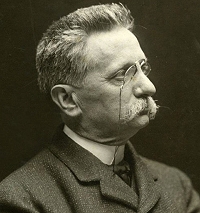
Lluis Domenech i Montaner
Catalan architect associated with the Modernisme movement. He designed the Palau de la Música Catalana and the Hospital de Sant Pau, both inscribed on the UNESCO World Heritage List in 1997.
Born on December 21, 1849
Died on December 27, 1923
Age at death: 74
Profession: Architect, Historian, Politician
Place of Birth: Barcelona, Spain
Place of Death: Barcelona, Spain
Lluís Domènech i Montaner (1849–1923) was a Spanish architect, historian, professor, and politician born in Barcelona, Catalonia. He worked within the Catalan Modernisme movement, combining modern construction techniques with ceramics, mosaics, stained glass, sculpture, and historical ornamentation. His principal works include Palau de la Música Catalana and Hospital de la Santa Creu i Sant Pau in Barcelona. Both buildings were inscribed on the UNESCO World Heritage List in 1997.
Early Life and Education
Lluís Domènech i Montaner was born in Barcelona in December 1849. His father, Pere Domènech i Saló, was a bookbinder and publisher, and his mother, Maria Montaner i Vila, came from Canet de Mar. He was the fourth of seven children and spent his summers in his mother's hometown.
He studied exact sciences at the University of Barcelona before moving to Madrid to study architecture. He received his architecture diploma on December 13, 1873.
During the early years of his career, he worked with architect Josep Vilaseca i Casanovas, with whom he studied European architecture and developed architectural projects.
Architecture and Academic Career
In 1875, Lluís Domènech i Montaner began teaching at the Barcelona School of Architecture. He became its director in 1900 and continued his association with the school until his retirement in 1920. His students included architects Antoni Gaudi, Josep Puig i Cadafalch, and Josep Maria Jujol.
In 1878, he published the essay En busca d'una arquitectura nacional (In Search of a National Architecture) in La Renaixença. The article examined how historical architectural traditions could be combined with contemporary construction methods.
His designs incorporated exposed brickwork, iron structures, ceramic tiles, stained glass, and sculpture. He collaborated with artists and craftspeople, including Eusebi Arnau, Lluís Bru, and Gaspar Homar.
Among his early commissions was the Montaner i Simón Publishing House (1881–1885) in Barcelona. For the 1888 Barcelona Universal Exposition, he designed the Hotel Internacional and a café-restaurant later known as Castell dels Tres Dragons.
He subsequently designed several buildings in Reus, including the Institut Pere Mata hospital complex and Casa Navàs (1901–1908), commissioned by Joaquim Navàs and Josepa Blasco. In Barcelona, he remodeled Casa Lleó Morera between 1902 and 1905.
Palau de la Música Catalana
Lluís Domènech i Montaner designed Palau de la Música Catalana for the choral society Orfeó Català. Construction took place between 1905 and 1908, financed largely through public subscriptions. The concert hall opened on February 9, 1908.
The building uses a metal structural system to create large interior spaces and extensive glass surfaces. Its concert hall incorporates stained glass, mosaics, sculpture, and natural lighting. The design accommodates both performances and the activities of the choral society.
Hospital de la Santa Creu i Sant Pau
Construction of the new Hospital de la Santa Creu i Sant Pau began in Barcelona in 1902. Lluís Domènech i Montaner designed the hospital as a complex of separate medical pavilions surrounded by gardens and connected by underground passages.
Natural lighting, ventilation, hygiene, and separation of medical departments were central to the project. Following his death, his son Pere Domènech i Roura continued construction. The hospital complex was officially inaugurated in January 1930.
The hospital and Palau de la Música Catalana were jointly recognized as UNESCO World Heritage Sites in 1997.
Political Activities
Lluís Domènech i Montaner participated in movements advocating Catalan culture and regional self-government. He was active in Centre Català, Lliga de Catalunya, and Unió Catalanista, serving as president of the latter two organizations.
In 1892, he presided over the Manresa assembly, which prepared the Bases de Manresa, a document outlining proposals for Catalan self-government.
He was elected to the Spanish parliament in 1901 as a representative of Barcelona and served until 1905. He also held the presidency of the cultural institution Ateneu Barcelonès on several occasions.
Writing and Historical Research
Following his father's death in 1873, Lluís Domènech i Montaner worked in the family publishing and bookbinding business. He designed book covers, illustrations, and publishing materials and participated in editorial projects, including Historia general del arte.
He published essays on architecture, Catalan history, medieval monuments, and heraldry. His research included the monastery of Poblet, the early Christian site of Centcelles, and Catalan coats of arms.
Several of his historical studies were published after his death, with assistance from his son Fèlix Domènech i Roura.
Family and Death
In 1875, Lluís Domènech i Montaner married Maria Roura. They had eight children, five sons and three daughters. His son Pere Domènech i Roura became an architect and worked on his father's projects. His son-in-law Francesc Guàrdia i Vial also collaborated on architectural commissions.
Lluís Domènech i Montaner died in Barcelona on December 27, 1923. He was buried in the Sant Gervasi Cemetery in Barcelona.
Major Architectural Works
1881–1885 - Montaner i Simón Publishing House, Barcelona (Publishing House)1888 - Castell dels Tres Dragons, Barcelona (Exposition Café-Restaurant)
1888 - Hotel Internacional, Barcelona (Exposition Hotel)
1897–1912 - Institut Pere Mata, Reus (Hospital Complex)
1900 - Casa Rull, Reus (Residence)
1900–1903 - Fonda Espanya, Barcelona (Hotel Interiors)
1901–1908 - Casa Navàs, Reus (Residence and Shop)
1902–1905 - Casa Lleó Morera, Barcelona (Building Remodeling)
1902–1930 - Hospital de la Santa Creu i Sant Pau, Barcelona (Hospital Complex)
1905–1908 - Palau de la Música Catalana, Barcelona (Concert Hall)
1908–1911 - Casa Fuster, Barcelona (Residential Building)
1911–1912 - Casa Gasull, Reus (Residential and Commercial Building)
Books and Historical Studies
1878 - En busca d'una arquitectura nacional (Essay)1921 - Centcelles: Baptisteri i Cellae-Memoriae de la primitiva església metropolitana de Tarragona
1922 - Armorial històric de Catalunya
1925 - Història i arquitectura del monestir de Poblet (Posthumous)
1930 - La iniquitat de Casp i la fi del Comtat d'Urgell (Posthumous)
1936 - Ensenyes nacionals de Catalunya (Posthumous)
Source: Biyografiler.com
Frequently asked questions about Lluis Domenech i Montaner
Who is Lluis Domenech i Montaner?, Lluis Domenech i Montaner biography, Lluis Domenech i Montaner life story, Lluis Domenech i Montaner age, Lluis Domenech i Montaner facts, Lluis Domenech i Montaner birthplace, Lluis Domenech i Montaner photos, Lluis Domenech i Montaner videos, Lluis Domenech i Montaner career
Related Biographies

Lamine Yamal
Professional footballer

Brad Pitt
Actor

Erling Haaland
Professional footballer

Leonardo DiCaprio
Actor

Sam Altman
Entrepreneur, Investor, CEO

Kylian Mbappe
Professional footballer

Marc Andreessen
Engineer, Entrepreneur

Manuel Pellegrini
Football Manager, Former Professional Footballer

Manuel Neuer
Professional footballer

Malin Maria Akerman
Model, Actress

Malcolm McDowell
Actor, Voice Actor

Margaret Mitchell
Novelist, Journalist
Lamine Yamal
Professional footballer

Scott Bessent
Politician, Investor
Erling Haaland
Professional footballer

Elon Musk
Entrepreneur, Businessperson, Engineer

Hailey Bieber
Model, Entrepreneur

Penelope Cruz
Actress