
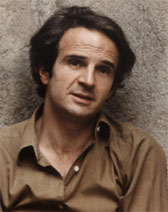
Francois Truffaut
Pioneer of the French New Wave
Born on February 6, 1932
Died on October 21, 1984
Age at death: 52
Profession: Film Director, Screenwriter, Producer
Place of Birth: Paris, France
Place of Death: Neuilly-sur-Seine, France
François Truffaut, whose full name was François Roland Truffaut, was one of the leading figures of the French New Wave movement and an influential director, screenwriter, and producer who left a lasting mark on world cinema.
François Truffaut was born in 1932 as the child of an extramarital relationship. His mother, Jeanine de Monferrand, was only seventeen years old at the time. His biological father, Roland Lévy, was a Jewish dentist. Shortly after François’ birth, his mother married the architect Roland Truffaut, from whom he later took his surname. He was sent to live with his grandmother for a period and endured a difficult childhood. After his grandmother’s death, he returned to his mother, where he became acutely aware that he was unwanted.
These early hardships later formed the autobiographical core of his 1959 film The 400 Blows. His love for cinema began at the age of eight after watching Paradis Perdu by Abel Gance. He frequently skipped school to attend movie screenings alone. By the age of fourteen, he had abandoned formal schooling and decided to educate himself independently by watching countless films and reading extensively. In 1948, he founded his own film club while working at a small grocery store to support himself.
At the cinema club “Cercle Cinémanie,” François Truffaut met the renowned film critic André Bazin, who would become both a mentor and a father figure. When Truffaut refused military service and was imprisoned, it was Bazin who helped secure his release.
In 1954, Truffaut began publishing film criticism in the influential magazine Cahiers du Cinéma. That same year, he directed two short films. In 1956, he worked as an assistant to Roberto Rossellini. In 1957, he married Madeleine Morgenstern, the daughter of a film distributor, and directed Les Mistons, further refining his cinematic technique.
In 1959, François Truffaut directed and wrote the screenplay for The 400 Blows, a film that would become one of the most important works in European cinema. Starring Jean-Pierre Léaud as Antoine Doinel, the film drew heavily from Truffaut’s own childhood and laid the foundations of the French New Wave. That same year, his daughter Laura was born.
In 1960, he contributed to the screenplay of Breathless by Jean-Luc Godard and directed Shoot the Piano Player. In 1962, his extensive interview with Alfred Hitchcock was published as Hitchcock/Truffaut, becoming one of the most important books on cinema ever written. That same year, he directed Jules and Jim, starring Jeanne Moreau, which won numerous awards and international acclaim.
Truffaut continued his prolific career with films such as Fahrenheit 451 (1966), Stolen Kisses (1968), The Wild Child (1970), Day for Night (1973), The Man Who Loved Women (1977), and The Last Metro (1980). His cinema frequently explored themes of childhood, melancholy, love, and women, combining irony with emotional depth. He often paid homage to his cinematic hero Jean Renoir in works such as The 400 Blows and Jules and Jim.
With Day for Night, released in 1973, François Truffaut won the Academy Award for Best Foreign Language Film. Although critics often favored his early films, his innovative use of the camera, editing, and narrative structure established a new cinematic language.
Between 1956 and 1978, Truffaut also appeared in small acting roles in his own films. International audiences recognized him as the French scientist Claude Lacombe in Close Encounters of the Third Kind by Steven Spielberg.
While working on The Little Thief, François Truffaut died of a brain tumor in 1984. The film was later completed by Claude Miller in 1988.
Awards
1959 – 13th Cannes Film Festival – Best Director (The 400 Blows)
Filmography
Director
1983 – Confidentially Yours
1981 – The Woman Next Door
1980 – The Last Metro
1979 – Love on the Run
1977 – The Man Who Loved Women
1975 – The Story of Adèle H.
1973 – Day for Night
1971 – Two English Girls
1970 – The Wild Child
1970 – Bed and Board
1969 – Mississippi Mermaid
1968 – Stolen Kisses
1968 – The Bride Wore Black
1966 – Fahrenheit 451
1964 – The Soft Skin
1962 – Jules and Jim
1960 – Shoot the Piano Player
1959 – The 400 Blows
Screenwriter
1988 – The Little Thief
1959 – The 400 Blows
1962 – Jules and Jim
1966 – Fahrenheit 451
Actor
1977 – Close Encounters of the Third Kind (Claude Lacombe)
1973 – Day for Night (Director Ferrand)
1970 – The Wild Child (Dr. Jean Itard)
Source: Biyografiler.com
Frequently asked questions about Francois Truffaut
Who is Francois Truffaut?, Francois Truffaut biography, Francois Truffaut life story, Francois Truffaut age, Francois Truffaut facts, Francois Truffaut birthplace, Francois Truffaut photos, Francois Truffaut videos, Francois Truffaut career
Related Biographies

Lamine Yamal
Professional footballer

Erling Haaland
Professional footballer

Sam Altman
Entrepreneur, Investor, CEO

Kylian Mbappe
Professional footballer

Giorgia Meloni
Politician, Journalist

Alice Weidel
Politician, Economist


Hongjoong
Singer, Rapper, Songwriter, Composer

Ludacris
Rapper, Actor

Kwon Eunbi
Singer

Sarah Wayne Callies
Actress, Screenwriter, Producer, Director

LaTavia Roberson
Singer, Actress, Entrepreneur

Zhang Zhidong
Entrepreneur, Engineer
Alice Weidel
Politician, Economist

Elena Andreyevna Rybakina
Professional Tennis Player

Jacqueline Bisset
Actress

Mira Murati
Engineer, Business Leader

Bill Gates
Entrepreneur, Software Developer