
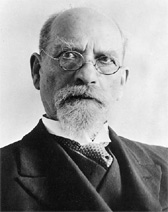
Edmund Husserl
Founder of phenomenology and a decisive figure in shaping philosophy as a rigorous science.
Born on April 8, 1859
Died on April 27, 1938
Age at death: 79
Profession: Philosopher, Professor
Place of Birth: Moravia (then part of the Austro-Hungarian Empire, today in the Czech Republic)
Place of Death: Freiburg im Breisgau, Germany
Edmund Husserl was a Jewish-born German philosopher and the founder of the phenomenological school of philosophy. In his early work, he addressed and elaborated critiques of historicism in logic and psychologism through analyses based on intentionality. With the method he developed, Husserl aimed to grant philosophy the status of a rigorous and exact science.
Edmund Husserl was born on April 8, 1859, in Moravia, a region that is today part of the Czech Republic. His full name was Edmund Gustav Albrecht Husserl. He completed his secondary education in 1876 at the Gymnasium in Olmütz (Olomouc). He then pursued studies in physics, mathematics, astronomy, and philosophy at the universities of Leipzig, Berlin, and Vienna. During these years, lectures given by Wilhelm Wundt, one of the founders of modern psychology, played a decisive role in awakening his interest in philosophy. While studying in Berlin, Husserl worked with Leopold Kronecker and the renowned mathematician Karl Weierstrass, while simultaneously attending philosophy courses. On November 22, 1882, he received his doctorate from the University of Vienna with a dissertation titled “Beiträge zur Theorie der Variationsrechnung” (Contributions to the Theory of the Calculus of Variations). He later became an assistant to Karl Weierstrass, who was known for his efforts to arithmetize analysis.
In the autumn of 1883, Husserl returned to Vienna to work under Franz Brentano. Brentano and his circle of students—among them Tomás Masaryk, who would later become the first president of Czechoslovakia—had a decisive influence on Husserl’s intellectual development. This circle preserved the Enlightenment spirit initiated by Holy Roman Emperor Joseph II, emphasizing religious tolerance and the search for a rational philosophy. Husserl’s effort to provide thought with a more precise rational foundation found strong support in this environment. From the outset, he believed that such a rational foundation could not be purely theoretical but had to include moral responsibility in the sense of ethical autonomy.
Between 1884 and 1886, Husserl remained with Brentano, further developing his philosophical knowledge. Psychology and philosophy became his primary areas of interest during this period. In 1886/87, he qualified as a lecturer (Privatdozent) in Halle with his habilitation thesis titled “Über den Begriff der Zahl. Psychologische Analysen” (On the Concept of Number: Psychological Analyses), under the supervision of Carl Stumpf. Husserl worked in Halle until 1901. In 1900–1901, he published his first major work, the two-volume Logical Investigations, which established his reputation as a leading philosopher.
In 1901, Husserl accepted a position at the University of Göttingen, where he worked until 1916. That year, he was appointed to a chair at the University of Freiburg, succeeding Heinrich Rickert. From the 1920s onward, Husserl became one of the most influential philosophers in Germany. In 1923, he was invited to move to the University of Berlin, but he chose to remain in Freiburg, where he stayed until his retirement in 1929. After his retirement, his position was taken over by Martin Heidegger.
From 1933 onward, Husserl encountered increasing difficulties due to the rise of Nazism in Germany. In 1934, because of his Jewish identity, he lost his right as a retired professor to use the university library. In 1935, believing it would be safer, he contacted the Prague Philosophical Circle to arrange for his manuscripts to be transferred to Prague. In 1937, he was barred from participating in the International Congress of Philosophy in Paris. After Husserl fell ill and died in 1938, his manuscripts were secretly transported to Belgium, where they were hidden until the end of the war. In 1939, German soldiers entering Prague completely destroyed an edition of Experience and Judgment.
Edmund Husserl converted to Lutheranism in Vienna. In 1887, he married Malvine Steinschneider, with whom he had three children. He died on April 27, 1938, at the age of 79, in Freiburg im Breisgau, Germany.
Source: Biyografiler.com
Frequently asked questions about Edmund Husserl
Who is Edmund Husserl?, Edmund Husserl biography, Edmund Husserl life story, Edmund Husserl age, Edmund Husserl facts, Edmund Husserl birthplace, Edmund Husserl photos, Edmund Husserl videos, Edmund Husserl career
Related Biographies

Lamine Yamal
Professional footballer

Sam Altman
Entrepreneur, Investor, CEO

Erling Haaland
Professional footballer

Kylian Mbappe
Professional footballer

Alice Weidel
Politician, Economist

Giorgia Meloni
Politician, Journalist


Hongjoong
Singer, Rapper, Songwriter, Composer

Ludacris
Rapper, Actor

Kwon Eunbi
Singer

Sarah Wayne Callies
Actress, Screenwriter, Producer, Director

LaTavia Roberson
Singer, Actress, Entrepreneur

Sydney Sweeney
Actress

Austin Abrams
Actor

Ma Huateng
Entrepreneur, Inventor
Lamine Yamal
Professional footballer

Ursula von der Leyen
Politician, Physician
Erling Haaland
Professional footballer