
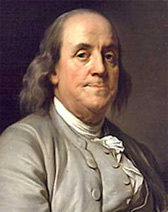
Benjamin Franklin
The Universal Mind of the American Enlightenment
Born on January 17, 1706
Died on April 17, 1790
Age at death: 84
Profession: Writer, Scientist, Inventor, Diplomat, Statesman
Place of Birth: Boston, Massachusetts Bay Colony, British America
Place of Death: Philadelphia, Pennsylvania, United States
Benjamin Franklin was an American publisher, writer, scientist, inventor, diplomat, and statesman. Alongside Thomas Jefferson and John Adams, he was a principal author of the Declaration of Independence, which secured his place among the Founding Fathers of the United States. Beyond his political legacy, Franklin played a decisive role in shaping the intellectual and institutional foundations of the country. He was the inventor of the lightning rod and the initiator of daylight saving time to maximize the use of sunlight. Reflecting his extraordinary versatility, an anthology describing his inventions and achievements famously declared: “Benjamin Franklin is everything except a poet.”
Benjamin Franklin was born on January 17, 1706, in Boston, as the son of a family with seventeen children, including half-siblings from his parents’ previous marriages. He was the fifteenth child of his father Josiah Franklin, a soap and candle maker, and the eighth child of his mother Abiah Franklin. As a child, Franklin was known for his love of swimming and was regarded as an excellent swimmer. At the age of ten, he left school and began an apprenticeship as a cutler, but realizing this trade did not suit him, he joined his brother William Franklin at age twelve, working in a printing house that published a liberal newspaper.
In 1722, at just sixteen years old, Franklin wrote his first series of essays titled Silence Dogood, presented as letters from a middle-aged woman. His sharp intellect, physical endurance, and writing ability made him exceptionally well-suited to publishing, and he quickly rose to become one of the most successful publishers in the colonies. When his relationship with his brother deteriorated, Franklin severed all ties with the business and decided to leave Boston in 1723.
Although he initially considered settling in New York, the lack of opportunities led him instead to Philadelphia. On his first day in the city, he met Deborah Read, who left a lasting impression on him and whom he later married. In 1729, Franklin and a partner purchased the Pennsylvania Gazette, transforming it into one of the most widely read publications in the country. Following his marriage to Deborah Read in 1730, he founded Poor Richard’s Almanack, named after the ship Poor Richard associated with his close friend Captain John Paul Jones. The witty aphorisms and wise advice published in the almanac became immensely popular and remain famous to this day.
Between 1732 and 1757, Franklin wrote under the pseudonym Richard Saunders. He founded the Junto Club, where politics, philosophy, science, and business were debated, and established institutions including a public library, a hospital, and a fire insurance company. He expanded his printing enterprises and played a key role in developing civic infrastructure. His first son, William Franklin, was born in 1731, followed by his second son, Francis Franklin, in 1732.
The tragic death of his son Francis in 1736 marked a turning point in Franklin’s life. That same year, he entered public service as clerk of the Pennsylvania Assembly and formally began his political career. In 1736, he also helped establish America’s first volunteer fire companies. In 1743, his daughter Sarah Franklin was born, and Franklin conducted studies concluding that storm movements could be observed and analyzed.
In 1744, Franklin introduced a stove of his own design, which he named the “Pennsylvania Fireplace.” This invention, later refined and known as the “Franklin Stove,” gained widespread attention for its efficiency. After retiring from publishing in 1748, he was elected to the Pennsylvania Assembly two years later, where he opposed influential landowning families resisting land taxes. Appointed as Postmaster General of British America, he reorganized and improved the colonial postal service.
During this period, Franklin conducted groundbreaking research on electricity. By identifying positive and negative electrical charges, he articulated the principle of the conservation of electricity. His famous kite experiment during a storm demonstrated that lightning was electrical in nature, leading to the invention of the lightning rod. These experiments were not without tragedy, as two of his assistants died from electric shocks. Franklin also introduced daylight saving time to promote greater use of natural sunlight.
In 1757, at the onset of colonial unrest, Franklin was sent to London to present colonial grievances. In 1765, he confronted Lord Grenville over the Stamp Act. His exposure of letters written by Massachusetts Governor Thomas Hutchinson in 1772, which insulted colonial citizens, greatly increased his reputation among the colonists and led to his election to the American Congress.
In 1776, Franklin collaborated with Thomas Jefferson and John Adams to draft the Declaration of Independence. That same year, Congress appointed him to a three-member commission to seek economic and military support from France. Franklin’s diplomacy proved highly successful in negotiations with French Foreign Minister Charles Gravier. Following the American Revolutionary War (1775–1783), he served as one of the diplomats negotiating peace with Britain. After the peace treaty was signed, he returned to America in 1785.
Franklin participated in the Philadelphia Constitutional Convention in 1787. He died on April 17, 1790, at the age of eighty-four. His portrait appears on the United States one-hundred-dollar bill, symbolizing his enduring legacy in American history.
Selected Quotes by Benjamin Franklin:
“Man makes counterfeit money; money makes counterfeit men.”
“Insanity is doing the same thing over and over again and expecting different results.”
“In this world nothing can be said to be certain, except death and taxes.”
“Who is more deceived than the man who deceives himself?”
“Well done is better than well said.”
“Ambition and happiness never saw each other.”
“It is easier to prevent bad habits than to break them.”
“Those who are good at making excuses are rarely good at anything else.”
Source: Biyografiler.com
Frequently asked questions about Benjamin Franklin
Who is Benjamin Franklin?, Benjamin Franklin biography, Benjamin Franklin life story, Benjamin Franklin age, Benjamin Franklin facts, Benjamin Franklin birthplace, Benjamin Franklin photos, Benjamin Franklin videos, Benjamin Franklin career
Related Biographies

Lamine Yamal
Professional footballer

Kylian Mbappe
Professional footballer

Erling Haaland
Professional footballer

Sam Altman
Entrepreneur, Investor, CEO

Bad Bunny
Rapper, Songwriter

Brad Pitt
Actor


Hongjoong
Singer, Rapper, Songwriter, Composer

Ludacris
Rapper, Actor

Kwon Eunbi
Singer

Sarah Wayne Callies
Actress, Screenwriter, Producer, Director

LaTavia Roberson
Singer, Actress, Entrepreneur
Erling Haaland
Professional footballer

Tim Berners Lee
Computer Scientist, Professor

Amber Heard
Actress, Model
Lamine Yamal
Professional footballer
Brad Pitt
Actor

John F. Kennedy
Politician, Statesman