
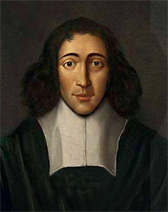
Baruch Spinoza
The Philosopher of God and Nature
Born on November 24, 1632
Died on February 21, 1677
Age at death: 45
Profession: Philosopher
Place of Birth: Amsterdam, Dutch Republic
Place of Death: The Hague, Dutch Republic
Baruch Spinoza was a Dutch philosopher of Sephardic Jewish origin. He was born on November 24, 1632, in Amsterdam, as the son of a merchant family. His family was Jewish and had fled the pressures of the Inquisition in Portugal, first settling in Nantes and later arriving in Amsterdam in 1622. His father served as the director of the synagogue and the Jewish school in Amsterdam. The family intended for Spinoza to be raised as a Jewish rabbi and provided him with every possible educational opportunity toward that goal.
Because of this upbringing, Baruch Spinoza learned Hebrew at an early age in Jewish schools and synagogues and became familiar with the works of Jewish and Arab theologians. In 1650, he began studying Latin, natural sciences (physics, chemistry, mechanics, astronomy, and physiology), and philosophy at the school of Franciscus van den Enden. With Van den Enden’s guidance, he also learned the subtleties of René Descartes’ philosophy.
An early thinker of the Enlightenment, Baruch Spinoza developed modern views on the universe and the individual, introduced pioneering critiques of sacred texts, and gradually came to be regarded as one of the leading rationalists of seventeenth-century philosophy. He formulated highly controversial ideas concerning the authenticity of the Hebrew Bible and the nature of God. At the age of 23, he was ostracized by the Jewish community, including members of his own family. His books were later placed on the Catholic Church’s Index of Forbidden Books. Although he was frequently accused of atheism by his contemporaries, he never denied the existence of God in any of his works.
Like many philosophers who were not fully understood in their own time, Baruch Spinoza became the subject of deep misunderstanding. In a striking paradox, he was considered one of the greatest enemies of religion, while at the same time it was claimed that the fundamental source of his philosophy was the love of God. Despite these contradictions, it can be said that Spinoza lived the life of a true sage.
After his father’s death in 1654, Baruch Spinoza was accused in 1655 by the Jewish communal court of heresy, materialism, and showing contempt for the Torah. During these interrogations, he defended the view that God possessed a form of substance rather than a personal body. Ultimately, the rabbis accused him of being an enemy of religion and attempted to force him into repentance. During this same year, Spinoza completed his work Tractatus de Deo et Homine et Eiusque Felicitate (also known as Short Treatise on God, Man, and His Well-Being). Although not considered a powerful work in itself, it is regarded as containing the core theses of Spinoza’s philosophy.
In 1656, at the age of 32, Baruch Spinoza was formally excommunicated by the Amsterdam Synagogue for defending the claims that God is identical with the universe and the workings of nature, that God has no personal attributes, and that the Torah is a metaphorical and symbolic book rather than a literal description of divine nature. Following his excommunication, he Latinized his name to Benedictus, the Latin equivalent of Baruch.
The central idea that led to his excommunication was his rejection of the notion, common to revealed religions, that God exists in a separate heavenly realm. For Spinoza, God exists within the world itself. God is nature, and nature is God. Spinoza’s conception of God is therefore a form of pantheism.
After his expulsion, Baruch Spinoza devoted himself to a life of dignity, solitude, and intellectual discipline. In 1660, the Amsterdam Synagogue reported him to local authorities as “a threat to all religion and morality.” In 1661, he left Amsterdam and settled in Rijnsburg, where he began writing his most famous work, Ethica. In 1670, he moved to The Hague, where he lived on Stille Veerkade.
The only works published during Baruch Spinoza’s lifetime were his commentary on Descartes’ Principles of Philosophy and Theological-Political Treatise. His masterpiece, Ethica, was completed but not published during his lifetime and appeared posthumously in 1677. His other writings were compiled by his followers from notes and unfinished manuscripts. His greatest work is widely considered to be Ethica.
Baruch Spinoza died on February 21, 1677, in The Hague, at the age of 45, from a lung disease.
Works of Spinoza:
1675 – Ethica
– Short Treatise on God, Man, and His Happiness
– Political Treatise
– On the Improvement of the Understanding
– Geometrical Demonstration of the Principles of Descartes’ Philosophy, Parts I and II
– Theological-Political Treatise
A contemporary philosopher, Gottfried Wilhelm Leibniz, commented on Spinoza as follows:
“Spinoza never appears as a great master of the art of demonstration. The mind of this writer seems very confused and tortured. He rarely follows clear and natural paths, preferring steep roads and long detours. Most of his demonstrations bewilder rather than illuminate.”
Source: Biyografiler.com
Frequently asked questions about Baruch Spinoza
Who is Baruch Spinoza?, Baruch Spinoza biography, Baruch Spinoza life story, Baruch Spinoza age, Baruch Spinoza facts, Baruch Spinoza birthplace, Baruch Spinoza photos, Baruch Spinoza videos, Baruch Spinoza career

Lamine Yamal
Professional footballer

Erling Haaland
Professional footballer

Sam Altman
Entrepreneur, Investor, CEO

Kylian Mbappe
Professional footballer

Giorgia Meloni
Politician, Journalist

Alice Weidel
Politician, Economist


Hongjoong
Singer, Rapper, Songwriter, Composer

Ludacris
Rapper, Actor

Kwon Eunbi
Singer

Sarah Wayne Callies
Actress, Screenwriter, Producer, Director

LaTavia Roberson
Singer, Actress, Entrepreneur
Lamine Yamal
Professional footballer
Sam Altman
Entrepreneur, Investor, CEO

Satya Nadella
Business Leader

Alex Krizhevsky
Computer Scientist
Alice Weidel
Politician, Economist

Angelina Jolie
Actress, Director, Human Rights Activist