
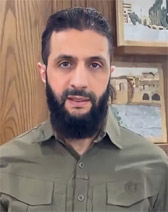
Ahmed al-Shara
Born on October 29, 1982
Age: 44
Profession: Head of State
Place of Birth: Riyadh, Saudi Arabia
Ahmed al-Shara has been the de facto head of state of Syria and the Commander-in-Chief of the Military Coordination Room since 8 December 2024.
Ahmed al-Shara was born on 29 October 1982 in Riyadh, the capital of Saudi Arabia, where his family was residing due to his father’s work. His father, Hussein al-Shara, was employed as a petroleum engineer in Saudi Arabia, while his mother worked as a geography teacher. His full birth name is Ahmed Hussein al-Shara, and he is also widely known by his nom de guerre, Abu Muhammad al-Julani. His family was originally from the Golan Heights and was forced to leave their home as a result of the Israeli occupation following the Six-Day War, which took place between 5 June and 10 June 1967. In 1989, al-Shara and his family returned from Saudi Arabia to Syria, settling in the Mezze neighborhood of Damascus.
Ahmed al-Shara traveled to Iraq in 2003 to fight against the United States occupation and subsequently joined Al-Qaeda. In 2006, he was captured by U.S. forces and detained for more than five years in various American-run facilities, including Abu Ghraib, Camp Bucca, Camp Cropper, and Al-Taji Prison. During his imprisonment, he acquired significant military experience and underwent ideological developments that later shaped his path toward leadership. Prior to severing ties with Al-Qaeda in 2016, he served as the leader of the now-defunct Al-Nusra Front, Al-Qaeda’s former Syrian affiliate. A photograph of Ahmed al-Shara taken after his capture by U.S. forces in Iraq in 2006 remains one of the most widely circulated images associated with his early militant period.
After distancing himself from Al-Qaeda, Ahmed al-Shara shifted his focus away from global jihadist ideology and toward establishing institutional governance within Syria, while actively seeking international legitimacy. In the territories under his control, he oversaw an administration that collected taxes, provided public services, and issued identification cards to residents. However, his leadership style has been criticized for authoritarian practices and for suppressing radical Islamist opposition. Under his leadership, Hayat Tahrir al-Sham (HTS) prioritized combating Al-Qaeda and ISIS in an effort to improve its standing with Western countries. HTS successfully defeated ISIS, Al-Qaeda, and most rival factions within its territory, consolidating control over much of Idlib province through the HTS-affiliated Syrian Salvation Government. In May 2013, the U.S. Department of State designated Ahmed al-Shara as a “Specially Designated Global Terrorist” and later announced a reward of 10 million USD for information leading to his capture.
On 28 September 2014, Ahmed al-Shara released an audio statement declaring that he would fight “the United States and its allies” and urged his fighters not to accept Western assistance while combating ISIS. In later years, he adopted a more moderate public stance, stating that he did not seek confrontation with Western countries and pledging to protect minority communities within Syria.
On 20 December 2024, following diplomatic talks held in Damascus between the United States and officials from Hayat Tahrir al-Sham, the U.S. government removed the 10 million USD bounty that had been placed on Ahmed al-Shara.
With the outbreak of the Syrian civil war in 2011, Ahmed al-Shara emerged as a key figure by founding the Al-Qaeda-linked Nusra Front, which later evolved into Hayat Tahrir al-Sham. Throughout the conflict against the government of Bashar al-Assad, he played a significant role and became widely known as the leader and military operations commander of HTS, often referred to simply as “Julani.”
Ahmed al-Shara is married to Latifa al-Durubi, and the couple has three children.
On 27 November 2024, Ahmed al-Shara led an HTS offensive against the pro-Assad Syrian Arab Army, known as the “Deterrence of Aggression – Rad‘ al-Udwan” operation. The rapidly advancing opposition forces cut the Aleppo–Damascus highway on 28 November, captured the 46th Regiment Base, and seized at least eight villages on the same day. Between 29 and 30 November, they took control of Aleppo, Syria’s second-largest city, followed by Hama on 4 December, Homs on 7 December, and finally Damascus on 8 December 2024. On that day, Bashar al-Assad fled to Moscow, where he was granted political asylum by the Russian government. The HTS leader announced the overthrow of Assad on Syrian state television the same day.
Following the fall of the Assad regime, Ahmed al-Shara delivered a speech at the Umayyad Mosque in Damascus on 8 December 2024, describing the collapse of the Assad government as “a new chapter in the history of the region.” He condemned Syria’s transformation into what he called “a playground for Iran’s ambitions,” characterized by sectarianism and corruption. On 12 December, he met with Turkish officials, marking his first diplomatic engagement since Assad’s removal.
On 29 January 2025, Ahmed al-Shara was officially declared the president of Syria for the transitional period by the country’s new leadership.
Source: Biyografiler.com
Frequently asked questions about Ahmed al-Shara
Who is Ahmed al-Shara?, Ahmed al-Shara biography, Ahmed al-Shara life story, Ahmed al-Shara age, Ahmed al-Shara facts, Ahmed al-Shara birthplace, Ahmed al-Shara photos, Ahmed al-Shara videos, Ahmed al-Shara career
Related Biographies

Lamine Yamal
Professional footballer

Erling Haaland
Professional footballer

Kylian Mbappe
Professional footballer

Austin Abrams
Actor

Bad Bunny
Rapper, Songwriter

Sam Altman
Entrepreneur, Investor, CEO


Hongjoong
Singer, Rapper, Songwriter, Composer

Ludacris
Rapper, Actor

Kwon Eunbi
Singer

Sarah Wayne Callies
Actress, Screenwriter, Producer, Director

LaTavia Roberson
Singer, Actress, Entrepreneur
Lamine Yamal
Professional footballer

Amber Heard
Actress, Model
Bad Bunny
Rapper, Songwriter
Erling Haaland
Professional footballer
Kylian Mbappe
Professional footballer
Austin Abrams
Actor